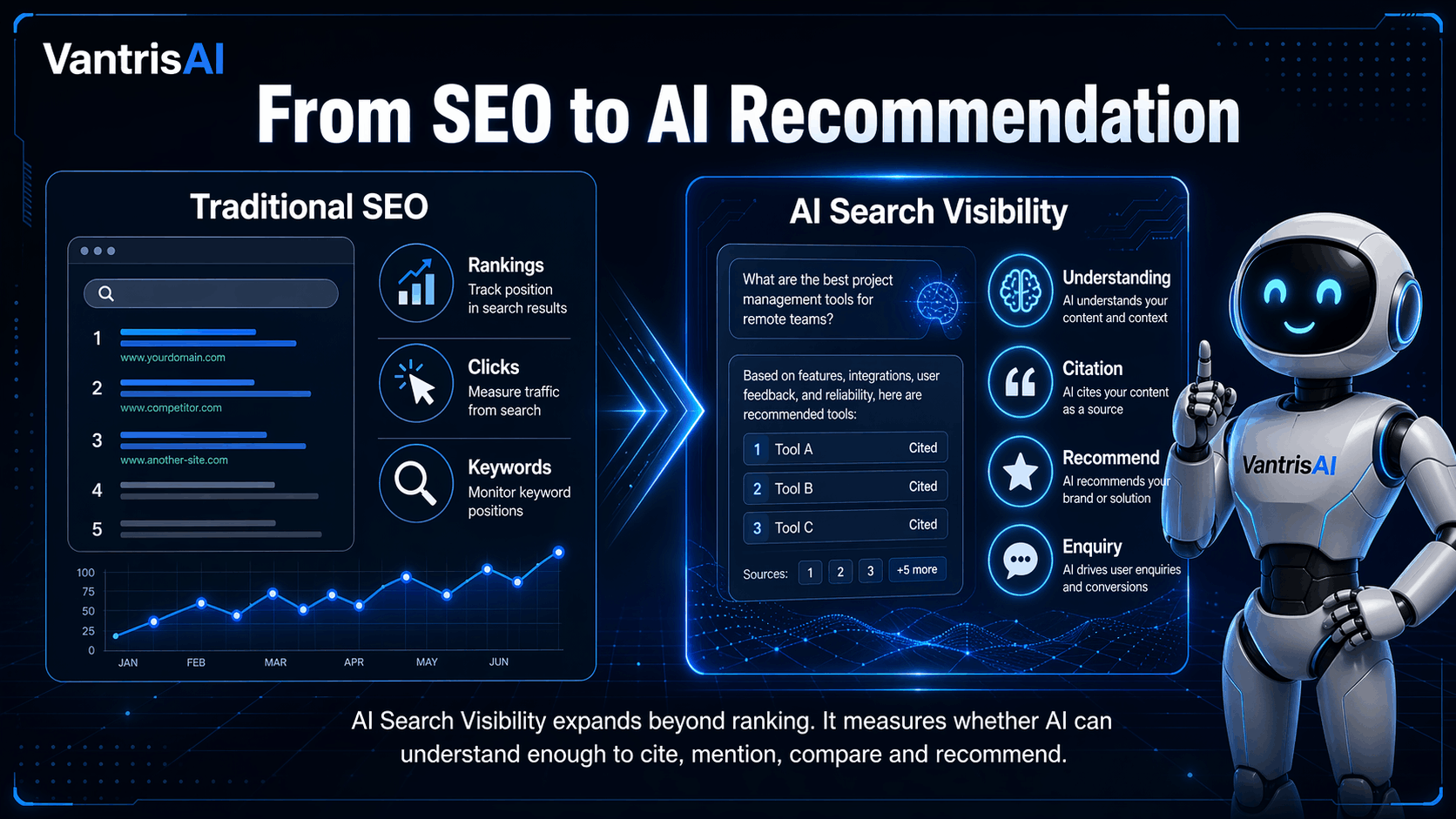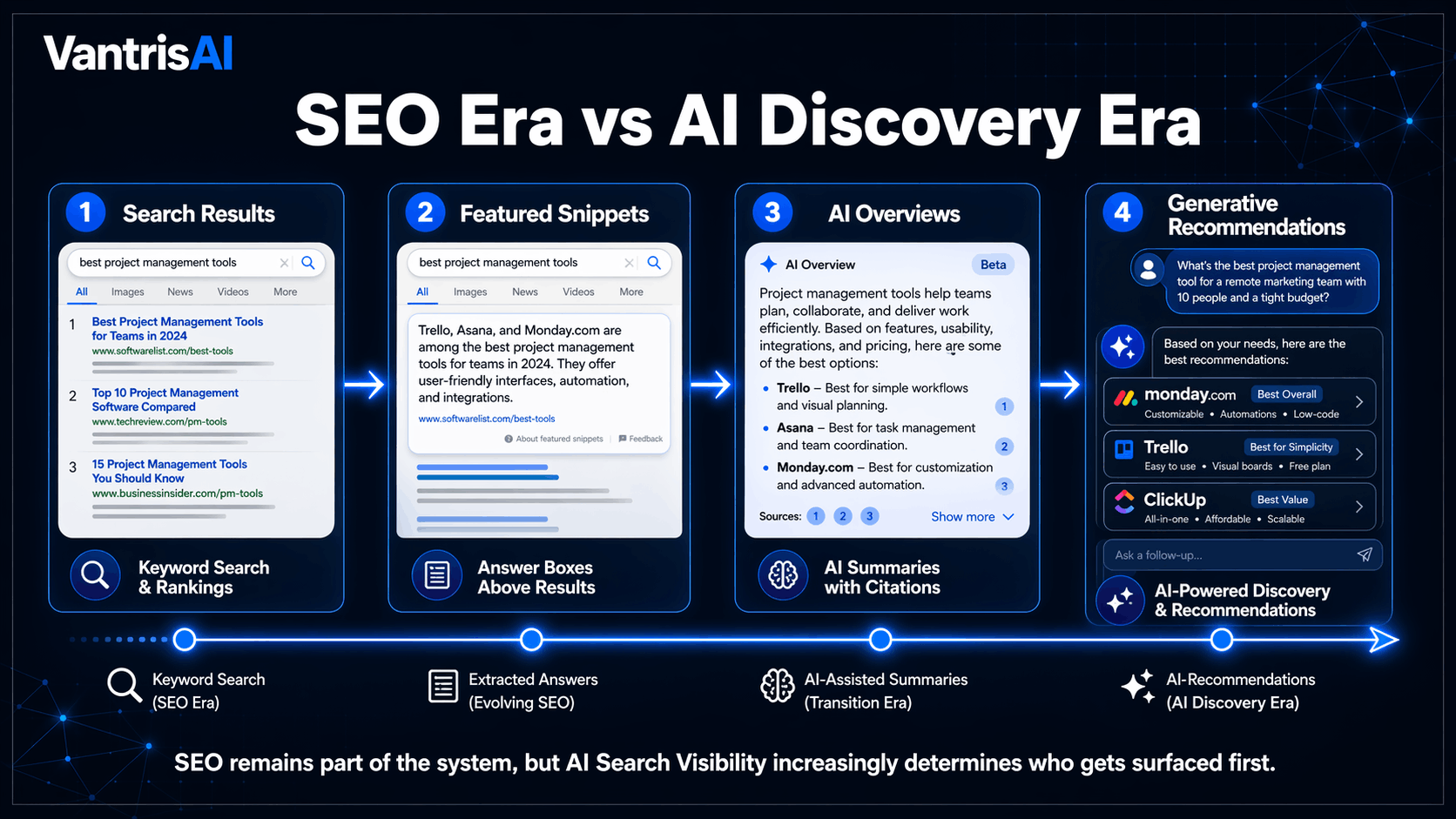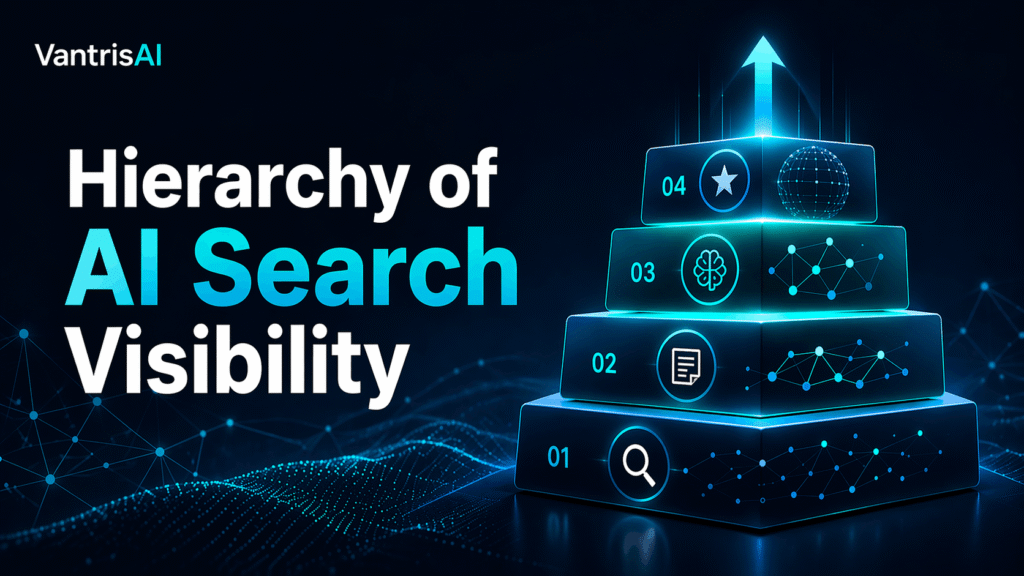
The hierarchy of AI search visibility is the progression a brand moves through inside AI-driven search systems: Mention, Cited, Compared, and Recommended.
Each level reflects a deeper layer of machine understanding and commercial trust.
For example, a brand that is merely mentioned is recognized or a brand that is cited is used as a source. A brand can also be compared has entered buyer consideration. A brand that is recommended has reached the highest level of AI confidence.
AI visibility is not one event. It is a climb.
Why This Matters
Many businesses still judge success by whether they appear somewhere in AI output. That is too shallow.
A brand can be visible in AI and still not generate commercial value. It can be mentioned without being trusted. It can be cited without being shortlisted. It can be compared without being preferred.
That is why the hierarchy matters. It shows where a business currently sits, what that level actually means, and what must happen to move upward.
Learn More About The Singapore AI Search Visibility Index 2026
The 4 Hierarchy of AI Search Visibility
Level 1: Mention
The Reality Check:
At this level, AI recognizes that your brand exists, but that is all. You may appear as one name in a list, a passing reference, or a broad answer, yet the system is not using your site as a trusted source and is not presenting you as a preferred option. This is awareness, not authority.
The Strategy:
The objective at this stage is to make your business clear enough for AI systems to identify and categorize. AI needs to understand who you are, what you do, what problem you solve, and what category you belong to. This is where AIO plays the strongest role. If your site is structurally unclear, your service pages are vague, or your brand signals are inconsistent, AI may not confidently surface you.
How to Get Here:
Make your brand easy to interpret. Ensure your homepage, about page, service pages, and contact page all clearly describe the business in consistent language. Strengthen entity clarity across your website, social profiles, and third-party listings. Use clean semantic structure, clear service definitions, and obvious brand-to-category associations. The goal is simple: help AI say, “I know this brand, and I understand what it does.”
Level 2: Cited
The Reality Check:
Being cited is a different level of visibility from being mentioned. A mention means AI knows your name. A citation means AI trusts a specific page, statement, or explanation on your site enough to use it as supporting evidence in a response. This is where your content starts becoming part of the answer itself.
The Strategy:
The goal here is to build content that AI can extract, trust, and attribute. This is where AEO becomes critical. Citation happens when your page reduces ambiguity and gives the model a clean, direct, fact-based answer to use. If your content is bloated, unfocused, or unclear, AI is less likely to rely on it.
How to Get Here:
Create fact-dense pages with clear purpose. Answer real user questions directly. Use strong headings, short answer blocks, concise explanations, and content that is easy to clip into an AI response. Ensure each page has a defined job: service page, methodology page, case study, FAQ, or proof asset. Add schema where relevant, but remember that schema supports clarity rather than replaces it. The core aim is to make your content easy to retrieve, easy to understand, and easy to trust.
Level 3: Compared
The Reality Check:
At this level, AI can place your brand beside alternatives in a commercial or evaluative discussion. You are no longer just known or cited. You are now part of the shortlist. This is important because being compared means the system sees enough positioning clarity to include you in buyer consideration.
The Strategy:
The objective is to make your differences legible. AI must understand not only what your business does, but how it differs from competitors, who it is best for, and in what scenario it is a stronger fit. This is where GEO becomes more influential. Comparison visibility depends on positioning clarity, not just content clarity.
How to Get Here:
State your positioning clearly. Define who you serve, what problem you solve, why your approach is different, and what type of buyer benefits most from your offer. Create content that helps AI understand distinctions: comparison pages, use-case sections, service breakdowns, buyer-fit explanations, and structured FAQs. AI cannot compare vague claims. It compares defined attributes, stated differences, and commercially relevant context.
Level 4: Recommended
The Reality Check:
This is the highest level of AI search visibility. At this stage, AI is willing to present your brand as a preferred solution in response to a user’s commercial intent. This is not caused by one article or one mention. It happens when enough relevance, clarity, trust, and proof signals align to make your business a confident choice.
The Strategy:
The objective is to become the safest and strongest answer for a specific buyer scenario. This is where strong GEO, reinforced by proof and trust signals, matters most. Recommendation is not only about being understood. It is about being believable, relevant, and commercially credible.
How to Get Here:
Strengthen the external and internal signals that support preference. Build case studies, testimonials, proof of outcomes, authority assets, strong service pages, and category-level content. Clarify why your business should be chosen, not just included. Improve third-party trust signals and make your brand’s strengths easy to verify. Recommendation usually appears when AI sees not just relevance, but confidence backed by evidence.
The Hierarchy of AI Search Visibility Matrix
Hierarchy of AI Search Visibility
How to Read the Hierarchy Properly
The hierarchy describes the visibility outcome.
- Mention = AI can recognize your brand
- Cited = AI can trust and use your content
- Compared = AI can place you among alternatives
- Recommended = AI can justify preferring your brand
The optimization layers explain how a business moves upward.
- AIO increases the probability of being mentioned
- AEO increases the probability of being cited
- GEO increases the probability of being compared
- Strong GEO + proof + trust signals increases the probability of being recommended
That distinction is important.
The hierarchy is the progress chart and AIO, AEO, and GEO are the operating system behind the chart.
Learn about our score framework and methodology
Why Most Businesses Misread Their Own AI Search Visibility
A lot of brands overestimate where they are.
If a brand appears once in a broad AI answer, that does not mean it is authoritative.
If a page is cited once, that does not mean the business is being preferred.
If a company has media mentions but is still not surfaced in commercial prompts, that does not mean AI is broken. It usually means the foundational layers are incomplete.
This is why AI visibility should not be treated as vanity.
The real question is not, “Did we appear?”
The better question is, “At what level are we appearing, and what does that level allow the business to achieve?”
See your current AI search visibility score
Key Takeaways
- Mention is awareness, not authority.
- Citation is where content starts becoming usable evidence.
- Comparison is where the brand enters buyer consideration.
- Recommendation is the highest level because AI is expressing confidence, not just recognition.
- The hierarchy measures outcome, while AIO, AEO, and GEO explain the path upward.
FAQ
What is the hierarchy of AI search visibility?
It is a four-level model that explains how a brand progresses inside AI search systems: Mention, Cited, Compared, and Recommended.
Why is being mentioned not enough?
Because mention only shows AI recognition. It does not mean your site is trusted, your content is used, or your brand is being preferred.
What makes a brand more likely to be cited?
Strong AEO. That means clear structure, direct answers, focused content, and pages that AI can confidently extract and attribute.
What makes a brand more likely to be recommended?
Recommendation usually requires strong GEO plus proof, trust, positioning clarity, and supporting authority signals.
If your brand is visible in AI but not yet being cited, compared, or recommended, the issue is usually not effort. It is structure, clarity, and signal quality. AI visibility improves when the right layers are fixed in the right order.