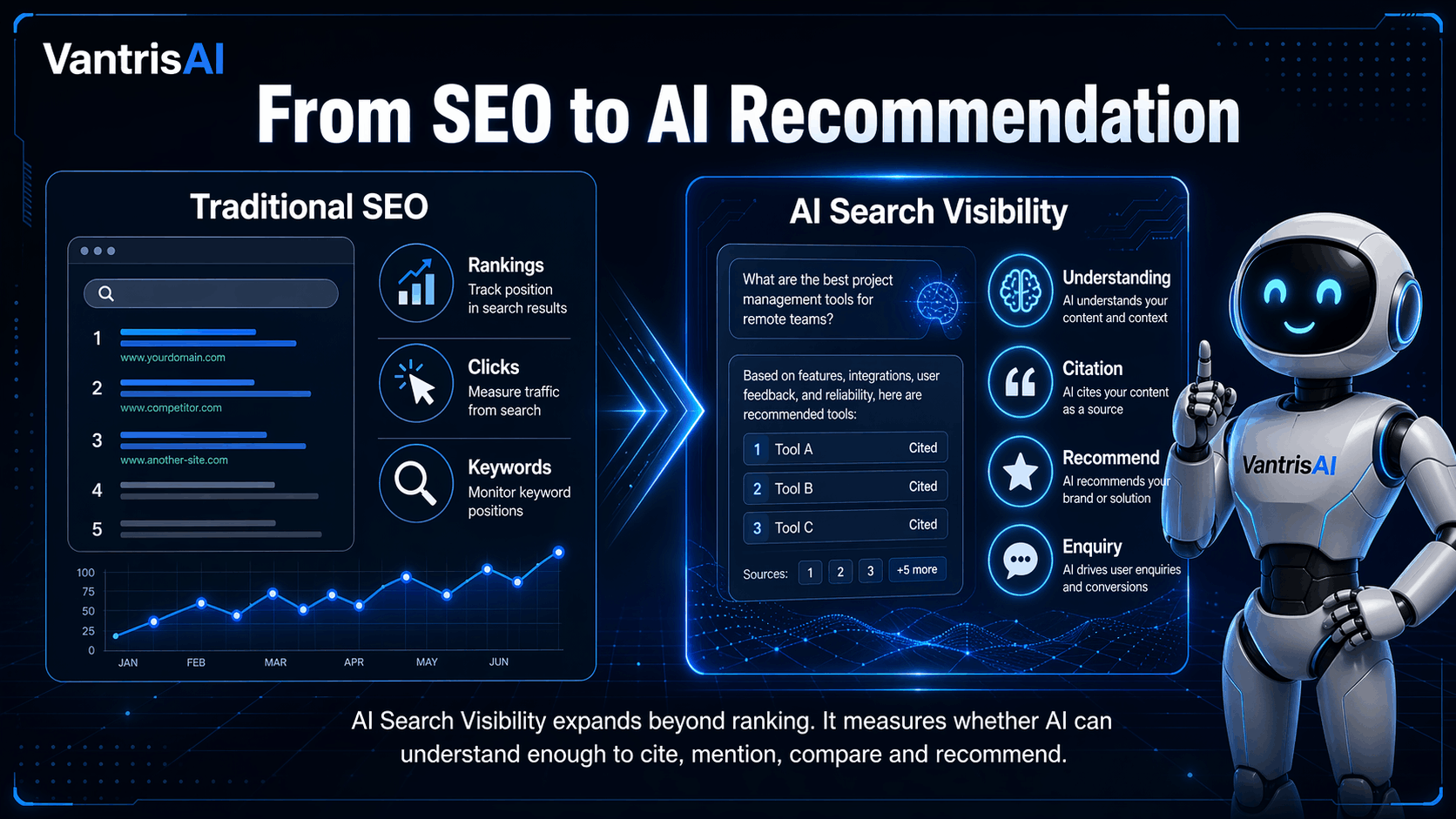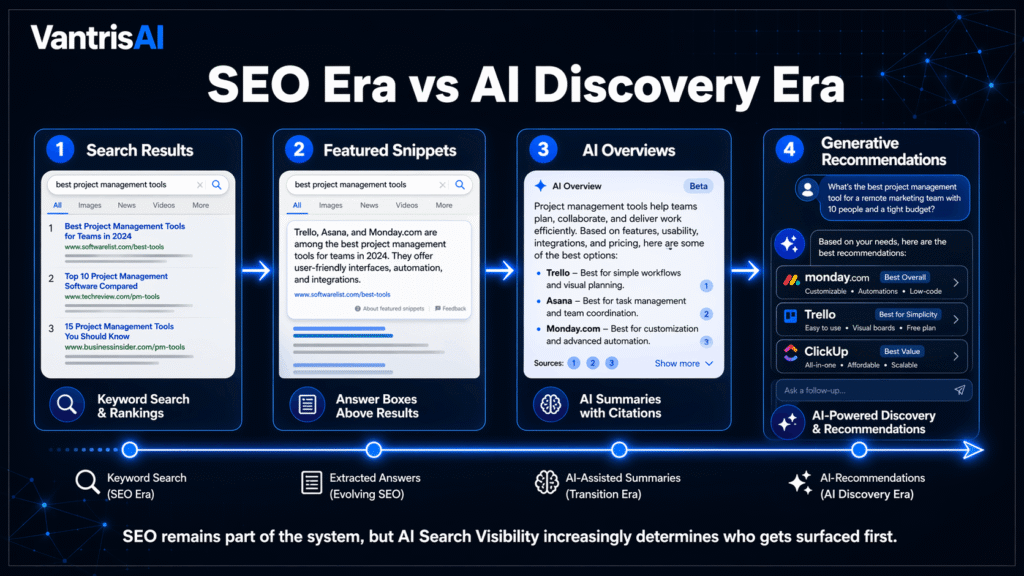
AI Search Visibility is replacing SEO as the primary discovery layer because users increasingly rely on AI systems to interpret, compare, and recommend businesses before they click. Traditional SEO still matters, but ranking alone is no longer enough to secure visibility in AI-generated answers, AI Overviews, and generative recommendation environments. The businesses that win next will not only rank; they will also be structurally understood and confidently surfaced by AI.
Many businesses still operate as if the internet works the same way it did five years ago. They assume that if they improve rankings, publish more content, and build backlinks, they are covered. But user behavior has shifted. Buyers now ask AI tools for summaries, recommendations, comparisons, and next-step guidance. That changes the economics of visibility. The business that gets selected inside the answer layer often gains an advantage before the user even begins traditional website research.
SEO Is Not Dead, but It Is No Longer the Whole Game
SEO still matters, but it no longer controls the full discovery journey because AI has inserted itself between the user and the click.
Key Points
- Search rankings still influence visibility.
- AI systems increasingly summarize results for users.
- Users now make decisions from AI answers, not just search result pages.
- Businesses need an expanded model, not a discarded one.
The phrase “SEO is dead” is usually lazy thinking. It ignores the fact that search engines still matter, websites still matter, and technical visibility still matters. But the opposite mistake is just as dangerous: assuming SEO alone is still sufficient. The truth is more nuanced and more useful. SEO remains foundational, but AI Search Visibility is becoming the layer that determines how that foundation gets interpreted.
This is similar to owning a good shop in a strong location but now operating in a city where digital concierges guide foot traffic. Your location still matters, your signage still matters, and your reputation still matters. But if the concierge does not understand your category or trust your offer, people may never be directed to you. AI now acts like that concierge.
Businesses that understand this shift do not abandon SEO. They evolve it. They build pages that can rank, but they also build pages that can be extracted, synthesized, cited, and recommended. That is the strategic upgrade.
User Behavior Has Moved Toward Answer-Led Discovery
Users increasingly prefer immediate summaries, comparisons, and recommendations, which makes AI-mediated discovery more influential than pure ranking visibility.
Key Points
- Users want faster decision support.
- AI reduces friction in research.
- Many prompts now begin with recommendation intent.
- Shortlists can form before website visits happen.
When a user types “best accounting firm for SME tax planning in Singapore” into a search engine, the old model assumed they would compare links manually. Today, they may ask ChatGPT, review a Google AI Overview, or use Gemini to summarize the differences between options. That is a different cognitive pathway. The user is outsourcing early-stage filtering.
This matters because the first filter shapes trust. If AI consistently introduces some businesses and never mentions others, it influences the market quietly but powerfully. The absence of a business in that layer may not show up in traditional reporting, but it can still reduce discovery opportunity.
From a commercial perspective, this means visibility is now partly pre-click and pre-site. That changes how businesses should think about content architecture.
The question is no longer only, “Can we rank?” It is also, “Can AI confidently explain us, connect us to the right category, and surface us under buying intent?”
Why Ranking Alone Is Losing Its Monopoly
Ranking alone is losing influence because AI systems are increasingly acting as interpreters, not just gateways.
Key Points
- AI can summarize multiple sources into one answer.
- Position one does not guarantee inclusion.
- AI may prefer clarity over simple ranking strength.
- Search is becoming more synthetic and less linear.
In traditional SEO logic, ranking first often meant owning the majority of attention. In AI-mediated environments, that relationship becomes less direct. A top-ranking page can still be excluded if its structure is unclear, if its entity signals are weak, or if it is less extractable than another source.
This is why some businesses feel confused. They may say, “We rank well, but we do not show up in AI Overviews,” or “We have traffic, but AI never mentions us.” These are not random failures. They usually point to structural issues. The site may satisfy search ranking mechanics but fail AI synthesis requirements.
AI systems need confidence. Confidence comes from clarity, consistency, and contextual support. A page that is less powerful in classic SEO terms can sometimes outperform a stronger-ranking page in AI contexts if it is more semantically coherent and easier to reuse as a trusted answer source.
AI Search Visibility Better Reflects How Buying Decisions Now Happen
AI Search Visibility is replacing SEO as the primary discovery model because it more accurately reflects how modern buyers research, compare, and decide.
Key Points
- Discovery is increasingly conversational.
- Buyers seek recommendation, not just information.
- AI compresses the research process.
- Trust is shaped earlier in the funnel.
Modern buyer journeys are more compressed than many marketing teams realize. AI tools reduce the number of steps needed to move from curiosity to shortlist. A user may ask one question and receive a comparison, criteria list, and recommended options all at once. That dramatically changes the value of being visible early.
Imagine two firms offering similar services.
One has strong rankings but generic, confusing service pages. The other has a more structured site with clear category positioning, proof content, direct-answer formatting, and strong entity reinforcement.
In an SEO-only world, the first firm might still dominate. In an AI-driven world, the second firm may earn the recommendation advantage.
That is why AI Search Visibility is not merely a technical concept. It is a strategic commercial lens. It asks whether your business can survive and win in a discovery environment where AI helps shape the shortlist.
AEO, AIO, and GEO Are the New Operational Model
AI Search Visibility replaces SEO as the primary discovery framework because it includes answer optimization, AI Overview visibility, and generative recommendation readiness.
Key Points
- AEO improves extractability.
- AIO improves AI Overview inclusion.
- GEO improves recommendation probability.
- Together, they cover the new discovery landscape.
If SEO was once the main operating system for digital discovery, AEO, AIO, and GEO now function like the upgraded stack. AEO ensures your content can be parsed into high-value answer fragments. AIO ensures your site is better positioned to appear in Google’s AI-generated result layer. GEO ensures your brand is more ready for recommendation in conversational AI environments.
These are not isolated tactics. They are overlapping systems. A service page that is well-structured for AEO may also improve AIO inclusion. A page with strong entity definition and trust framing may support GEO. The point is not to treat them as disconnected silos. The point is to recognize that visibility now requires broader optimization logic.
Businesses that continue using only an SEO lens may keep producing content that wins impressions but loses recommendation opportunities.
Businesses that adopt AI Search Visibility as the operating model are better positioned for the next phase of digital discovery.
What Replacing SEO Actually Means in Practice
Replacing SEO does not mean deleting old practices. It means evolving from ranking-centric optimization to AI-centric visibility architecture.
Key Points
- Keep technical SEO foundations.
- Upgrade content structure for AI extraction.
- Clarify service categories and entity relationships.
- Measure visibility in relation to recommendation and enquiries.
In practice, replacing SEO means changing what success looks like. The old benchmark was often rankings, clicks, and organic sessions. Those still matter, but they are no longer enough on their own. New questions must be added. Can AI explain our service clearly? Can AI connect our brand to the right category? Can AI cite our pages? Can AI recommend us under commercial prompts?
This requires stronger information design. Service pages need direct-answer blocks, clearer semantic hierarchy, less vague language, stronger internal linking, and better proof support. Businesses need pillar pages that define their categories, framework pages that explain methodology, and commercial pages that are precise enough for AI to classify.
The deeper shift is strategic. SEO was often about getting found. AI Search Visibility is about being chosen.
Conclusion
If your current growth strategy still depends mainly on rankings, traffic charts, and keyword wins, you may be measuring yesterday’s battlefield. The next layer of discovery is already here. Audit your visibility across AEO, AIO, and GEO, identify where AI fails to understand your business, and start building for recommendation, not just ranking.
Explore the VantrisAI methodology, review your AI visibility score, and move from being searchable to being selected.