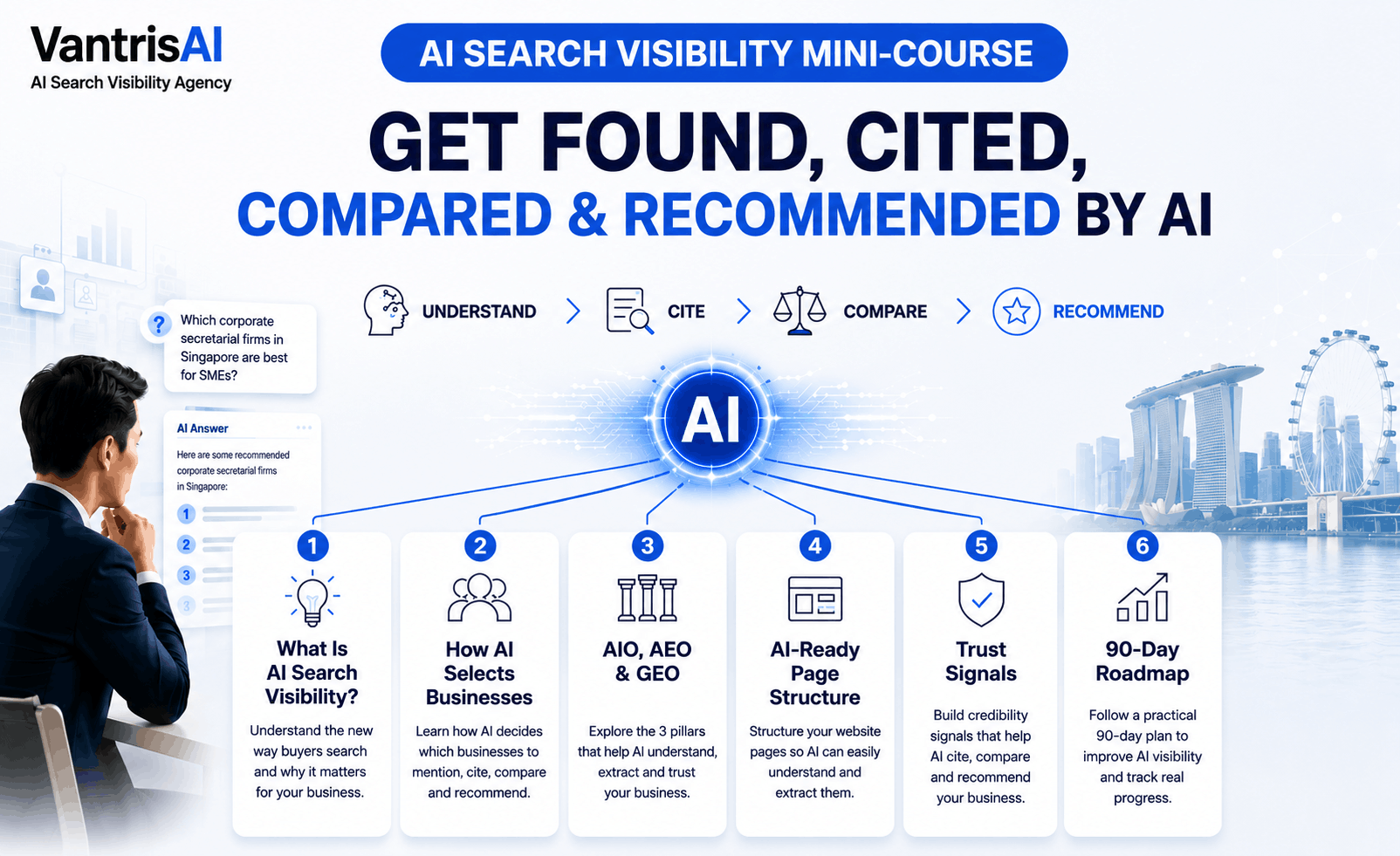
Table of Contents
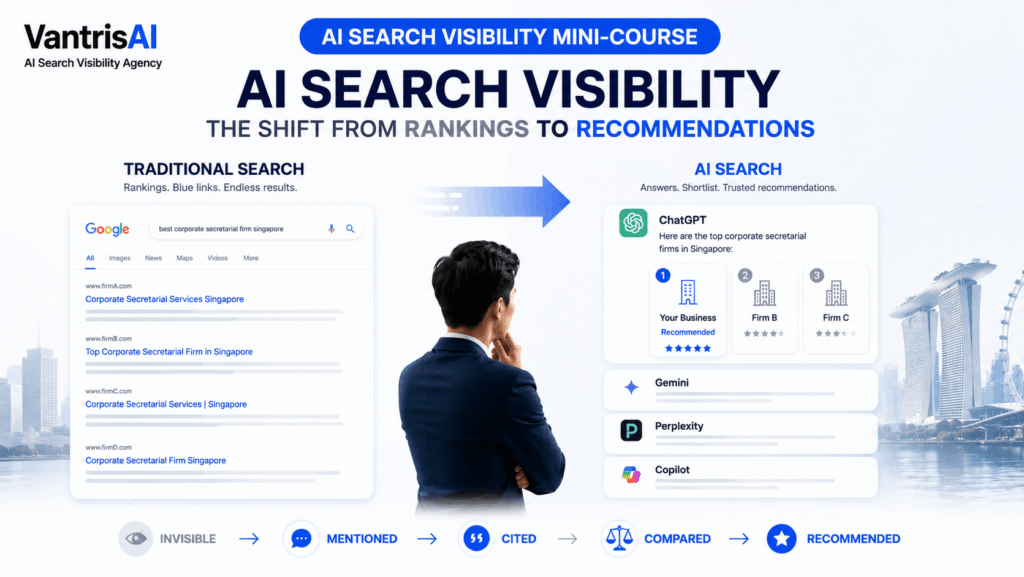
AI Search Visibility is the ability of your business to appear, be understood, be cited, be compared, and be recommended by AI tools when potential buyers ask questions related to your products, services, industry, or location.
Instead of only relying on Google rankings, businesses now need to make sure AI systems such as ChatGPT, Gemini, Perplexity, Copilot, and Google AI features can clearly understand who they are, what they do, who they help, why they are credible, and when they should be included in an answer.
For business owners, AI Search Visibility matters because buyers are no longer only searching. They are asking AI for advice, recommendations, comparisons, and shortlists.
If AI cannot understand your business, it may not include you.
Why AI Search Visibility Matters Now
For years, most businesses thought about online visibility in one way:
“How do we rank higher on Google?”
That question still matters.
But it is no longer the only question.
Today, buyers are not just typing keywords into Google and clicking through ten blue links. They are asking AI tools questions such as:
- “Who are the best corporate secretarial firms in Singapore?”
- “Which accounting firm should I use for a growing SME?”
- “What is the best B2B supplier for automotive parts in Singapore?”
- “Which law firm is suitable for commercial contract work?”
- “Who provides AI search visibility services for businesses?”
When a buyer asks AI a question like this, they are not looking for a long list of websites.
They are looking for a useful answer.
That answer may include a few companies, a comparison, a recommendation, or a short explanation of which business fits which need.
This changes the game.
In traditional search, a buyer may see many results and choose where to click.
In AI search, the buyer may only see a small number of businesses mentioned.
That means your business does not only need to be searchable.
It needs to be understandable, extractable, credible, and recommendable.
That is what AI Search Visibility is about.
What Is AI Search Visibility?
AI Search Visibility is the probability that your business can be found and included by AI systems when users ask relevant commercial questions.
It is not just about whether your website exists.
It is about whether AI can answer these questions clearly:
- What does this business do?
- Who does this business serve?
- What problem does this business solve?
- Where does this business operate?
- What services does this business provide?
- Why should this business be trusted?
- When should this business be recommended?
- How does this business compare with alternatives?
If AI cannot answer these questions confidently, your business may be skipped, even if you have a website.
This is why some companies appear in AI answers while others do not.
The companies that appear are not always the biggest.
They are not always the oldest.
They are not always the best.
Many times, they are simply the easiest for AI to understand, verify, and include.
AI Search Visibility Is Different From SEO Ranking
Traditional SEO focuses heavily on ranking pages on search engines.
AI Search Visibility focuses on whether AI systems can understand and use your business as part of an answer.
The difference is important.
A Google search result may show a list of pages.
An AI answer may summarise the topic, compare options, cite sources, and recommend a few providers.
That means your website has to do more than target keywords.
It must help AI understand your business as an entity.
An entity means a clearly identifiable thing.
For a business, this includes:
- Your company name
- Your category
- Your services
- Your location
- Your audience
- Your expertise
- Your proof
- Your reputation
- Your relationship to the topic
For example, if a business says:
“We provide trusted solutions for your needs.”
That is weak for AI.
It is vague.
AI does not know what the business provides, who it serves, or when to recommend it.
But if a business says:
“We help Singapore SMEs improve AI Search Visibility by restructuring their websites, service pages, and trust signals so AI tools can better understand, cite, and recommend them.”
That is clearer.
AI can identify the service, market, audience, and outcome.
This is why clarity matters.
AI does not reward vague marketing language.
It needs structured meaning.
The Old Search Journey vs The AI Search Journey
The old search journey looked like this:
- Buyer searches Google.
- Buyer sees many results.
- Buyer clicks a few websites.
- Buyer compares manually.
- Buyer submits an enquiry.
The AI search journey can look very different:
- Buyer asks AI for advice.
- AI explains the topic.
- AI mentions several providers.
- AI compares the options.
- Buyer shortlists from the answer.
- Buyer contacts one or two businesses.
This means the decision journey can become shorter.
The buyer may not visit ten websites.
The buyer may not compare twenty vendors.
The buyer may trust the AI summary enough to start with the companies AI includes.
This creates a new business risk.
If your business is not included in the AI answer, you may not enter the buyer’s shortlist at all.
That does not mean your business is bad.
It may simply mean your online information is not structured in a way that AI can understand and trust.
The 5 Stages of AI Search Visibility
At VantrisAI, we look at AI Search Visibility through five stages.
These stages help business owners understand where they are now and what needs to improve next.
Stage 1: Invisible
This is when AI does not mention your business at all for relevant questions.
For example, a buyer asks:
“Which companies provide AI search visibility services in Singapore?”
If your business does not appear, you are invisible for that query.
This usually happens when:
- Your website is unclear
- Your services are not described properly
- Your category is not obvious
- Your content is too thin
- Your trust signals are weak
- Your business is not connected to the right topics online
The first goal is to move from invisible to mentioned.
Stage 2: Mentioned
This is when AI knows your business exists and may include your name in an answer.
This is better than being invisible, but it is still early-stage visibility.
A mention does not mean AI trusts you enough to cite, compare, or recommend you.
It simply means your business has entered the conversation.
To move beyond mention, your website must provide clearer explanations, stronger structure, and more useful supporting information.
Stage 3: Cited
This is when AI uses your website or content as a source to support an answer.
Citation matters because it shows that AI can extract useful information from your content.
A business usually becomes more citable when its pages include:
- Clear definitions
- Direct answers
- Helpful explanations
- Structured service pages
- FAQs
- Use cases
- Comparison sections
- Evidence-backed claims
Being cited means your content is useful enough to support an AI-generated answer.
But citation is not the same as recommendation.
That requires stronger trust.
Stage 4: Compared
This is when AI can place your business alongside other businesses and explain differences.
For example, AI may say one company is suitable for enterprise clients, another is suitable for SMEs, and another has a stronger niche focus.
To be compared, AI needs to understand your positioning.
It needs to know:
- What you do differently
- Who you are best suited for
- What industries you serve
- What outcomes you deliver
- How you are different from alternatives
If your website only says generic things such as “quality service” and “professional team,” AI has very little to compare.
Strong positioning helps AI understand where you fit.
Stage 5: Recommended
This is the strongest stage.
This is when AI includes your business as a suggested provider for a relevant buyer question.
Recommendation requires more than visibility.
AI needs enough confidence to justify why your business should be included.
This confidence may come from:
- Clear service pages
- Strong About page
- Case studies
- Testimonials
- Founder or team credibility
- Consistent business information
- Third-party mentions
- Reviews
- Industry relevance
- Demonstrated experience
In simple terms:
AI needs to know what you do.
Then it needs to understand why you are credible.
Then it needs to know when to recommend you.
Why Some Competitors Appear in AI Before You
Many business owners assume that if a competitor appears in AI, the competitor must be better.
That is not always true.
Sometimes the competitor simply has clearer information online.
AI may mention a competitor because their website explains their services more clearly.
It may cite them because their content answers questions directly.
It may compare them because their positioning is easier to identify.
It may recommend them because their proof signals are stronger.
This means AI visibility is not only a marketing issue.
It is a clarity issue.
It is a structure issue.
It is a trust issue.
If your business is strong offline but unclear online, AI may not understand your real value.
That creates a gap between your actual credibility and your AI-visible credibility.
VantrisAI calls this the AI Visibility Gap.
The AI Visibility Gap
The AI Visibility Gap is the difference between how credible your business is in real life and how clearly that credibility appears to AI systems.
Many established businesses have this problem.
They may have years of experience, good clients, strong technical knowledge, and a proven track record.
But their website does not show it clearly.
Common problems include:
- Service pages that are too short
- Homepage copy that is too vague
- No clear industry positioning
- No case studies
- No founder or team authority
- No direct answers to buyer questions
- No structured FAQs
- No comparison content
- No proof of results
- No clear internal links between related pages
To a human buyer who already knows you, this may not matter much.
But to AI, missing information creates uncertainty.
And when AI is uncertain, it may choose another business that is easier to understand.
What AI Needs to Understand About Your Business
To improve AI Search Visibility, your website should help AI understand seven key things.
1. Your Business Category
AI needs to know what type of business you are.
Are you a law firm, accounting firm, corporate secretarial firm, B2B supplier, SaaS provider, consultancy, clinic, agency, or specialist service provider?
Do not assume AI will figure this out from your logo or brand name.
State your category clearly.
Example:
“VantrisAI is an AI Search Visibility specialist helping businesses improve how they appear in AI-generated answers.”
This is much clearer than:
“We help brands grow in the digital age.”
2. Your Core Services
AI needs to know what you actually provide.
Your services should be described in plain language.
Avoid hiding important services behind clever names.
If your business provides tax advisory, say tax advisory.
If you provide commercial litigation, say commercial litigation.
If you provide AI Search Visibility audits, say AI Search Visibility audits.
AI needs clear service labels before it can connect your business to relevant buyer questions.
3. Your Ideal Customer
AI needs to know who your business is for.
For example:
- SMEs
- Founders
- Startups
- Enterprise clients
- Professional services firms
- B2B suppliers
- Singapore businesses
- Regional companies
- Specific industries
When your audience is clear, AI has a better chance of recommending you in the right context.
A business that serves “everyone” is harder to position.
A business that serves a specific audience is easier to understand.
4. Your Location or Market
Location still matters.
Many AI queries include geography, even when users do not phrase it perfectly.
A buyer may ask:
“Who can help with AI search visibility in Singapore?”
If your website does not clearly mention your location or market, AI may not associate you with that query.
Your pages should make your market clear.
For VantrisAI, that means Singapore, Singapore businesses, and where relevant, regional B2B or professional services markets.
5. Your Differentiation
AI needs to understand why your business is different from alternatives.
This does not mean making exaggerated claims.
It means explaining your specific angle.
For example:
- Do you specialise in a specific industry?
- Do you serve a specific type of customer?
- Do you have a unique process?
- Do you have proof from your own case study?
- Do you provide a diagnostic before implementation?
- Do you focus on business outcomes instead of vanity metrics?
Differentiation helps AI compare you.
Without differentiation, your business becomes interchangeable.
6. Your Proof
AI needs evidence.
If your website claims that you are experienced, trusted, reliable, or effective, the page should support those claims.
Proof can include:
- Case studies
- Client results
- Testimonials
- Before-and-after examples
- Founder experience
- Media mentions
- Awards
- Certifications
- Screenshots
- Research
- Data
- Published frameworks
For AI search, proof is not decoration.
Proof helps AI decide whether your business is credible enough to include.
7. Your Best-Fit Use Cases
AI often answers questions based on fit.
A buyer may not ask:
“Which company is the most famous?”
They may ask:
“Which company is suitable for a small business?”
Or:
“Which provider can help a B2B company improve AI visibility?”
This is why your website should explain when your business is the right fit.
For example:
“VantrisAI is suitable for business owners who want to understand why AI tools are not mentioning, citing, or recommending their business, and what needs to be fixed first.”
This helps AI match your business to the right buyer intent.
How to Know If Your Business Has an AI Visibility Problem
You may have an AI Search Visibility problem if:
- AI does not mention your business for relevant service queries
- AI mentions competitors but not you
- AI cannot explain what your company does
- AI gives outdated or incomplete information about your business
- AI does not cite your website
- AI cannot compare your business clearly
- AI recommends other companies even when you are relevant
- Your website has service pages but no clear answers
- Your website has claims but little proof
- Your online presence is inconsistent across platforms
This does not mean your business has failed.
It means your digital structure may not be AI-ready.
A Simple AI Search Visibility Diagnostic
Ask these questions about your current website.
Can AI understand you?
- Is your business category clear?
- Are your services clearly named?
- Is your location or market obvious?
- Is your ideal customer clear?
- Is your positioning easy to explain?
This relates to AIO: AI Overview Optimisation.
Can AI extract answers from you?
- Do your pages answer buyer questions directly?
- Do you have useful FAQs?
- Do you define important terms?
- Do you explain your process?
- Do you have structured sections and headings?
- Do your pages contain enough text for AI to understand?
This relates to AEO: Answer Engine Optimisation.
Can AI trust and include you?
- Do you show proof?
- Do you have case studies?
- Do you have testimonials?
- Do you have founder or team credibility?
- Do other sources mention your business?
- Are your business details consistent online?
This relates to GEO: Generative Engine Optimisation.
Together, these three pillars form the foundation of AI Search Visibility.
The 3 Pillars of AI Search Visibility
VantrisAI uses 3 pillars of AI Search Visibility to diagnose why a business may or may not appear in AI search.
AIO: Can AI Understand You?
AIO stands for AI Overview Optimisation.
This pillar looks at whether AI can understand your business, your services, your category, and your relevance to a topic.
If AIO is weak, AI may not know where to place your business.
You may be real.
You may be credible.
You may be experienced.
But if the website does not explain your entity clearly, AI may not understand you well enough to include you.
AEO: Can AI Extract You?
AEO stands for Answer Engine Optimisation.
This pillar looks at whether AI can extract useful answers from your website.
If AEO is weak, your pages may be too vague, too thin, or too difficult to use as a source.
Strong AEO content usually includes:
- Direct answers
- Clear headings
- Structured explanations
- FAQs
- Lists
- Tables
- Definitions
- Step-by-step sections
- Specific examples
AEO helps your business become citable.
GEO: Should AI Trust and Recommend You?
GEO stands for Generative Engine Optimisation.
This pillar looks at whether AI has enough trust signals to include your business in a generated recommendation.
If GEO is weak, AI may understand what you do but still avoid recommending you.
Strong GEO signals include:
- Case studies
- Client outcomes
- Reviews
- Testimonials
- Founder credibility
- Author profiles
- Media mentions
- External references
- Consistent brand presence
GEO helps your business move from being visible to being trusted.
Why Random Blog Content Is Not Enough
Many businesses respond to AI search by publishing more blog posts.
That may help if the content is strategic.
But random content alone is not enough.
AI visibility is not created by volume alone.
It is created by structure, clarity, coverage, and proof.
A business can publish 100 articles and still remain unclear.
Another business can publish fewer pages but structure them properly around its services, audience, proof, and expertise.
The goal is not to create content for the sake of content.
The goal is to make your business easier for AI to understand, extract, trust, and recommend.
What Business Owners Should Fix First
If you are new to AI Search Visibility, start with these five areas.
1. Clarify Your Homepage
Your homepage should quickly explain:
- Who you are
- What you do
- Who you help
- What outcome you create
- Why you are credible
- What action the visitor should take next
If your homepage is vague, AI may struggle to understand your business.
2. Strengthen Your Service Pages
Each service page should answer:
- What is this service?
- Who is it for?
- What problem does it solve?
- How does it work?
- What outcome can it support?
- Why should the business be trusted?
- What should the visitor do next?
Thin service pages are a major AI visibility weakness.
3. Add Direct Answer Sections
Each important page should answer the main question early.
For example, a page about AI Search Visibility should define AI Search Visibility near the top.
Do not make AI or the reader search through the page to understand the topic.
Clear answers improve extraction.
4. Add Proof
Proof turns claims into evidence.
If you say you help businesses improve visibility, show how.
Use case studies, screenshots, testimonials, founder notes, results, and examples.
AI needs evidence to support inclusion.
5. Build Internal Links Between Related Pages
Internal links help users and AI understand how your topics connect.
A mini-course like this should link from one lesson to the next.
Your service pages should link to case studies.
Your case studies should link back to your service pages.
Your audit page should connect to educational articles.
This creates a clearer topical network.
Common Mistakes That Hurt AI Search Visibility
Many businesses do not have an AI visibility problem because they are not good enough.
They have a visibility problem because their website is not clear enough.
Common mistakes include:
- Using vague slogans instead of clear explanations
- Writing for branding but not for understanding
- Having thin service pages
- Publishing blogs that do not connect to core services
- Making claims without proof
- Hiding important information in images
- Not explaining who the service is for
- Not having FAQs
- Not having case studies
- Not showing founder or team credibility
- Not making the location or market clear
- Not internally linking related pages
- Not checking whether AI can actually mention or cite the business
These mistakes are fixable.
But they must be diagnosed first.
AI Search Visibility Is a Business Growth Issue
AI Search Visibility is not just a technical marketing topic.
It affects business growth.
If buyers are asking AI for recommendations, comparisons, and advice, then AI becomes part of the buyer journey.
That means your business needs to be present where decisions are being shaped.
For business owners, the real question is not:
“Are we ranking for keywords?”
The better question is:
“When a buyer asks AI who they should consider, are we part of the answer?”
That is the commercial importance of AI Search Visibility.
It connects visibility to opportunities, clients, revenue, and growth.
Summary
AI Search Visibility is the ability of your business to be understood, cited, compared, and recommended by AI systems.
It matters because buyers are increasingly using AI tools to ask for advice, explanations, comparisons, and provider recommendations.
To improve AI Search Visibility, your business must make it easy for AI to understand:
- What you do
- Who you serve
- Where you operate
- Why you are credible
- What services you provide
- What problems you solve
- What proof supports your claims
- When you should be recommended
The businesses that win in AI search may not always be the biggest.
They are often the clearest, most structured, most credible, and easiest to include.
If your business is strong but AI is not mentioning you, the issue may not be your capability.
It may be your AI visibility structure.
Next Lesson
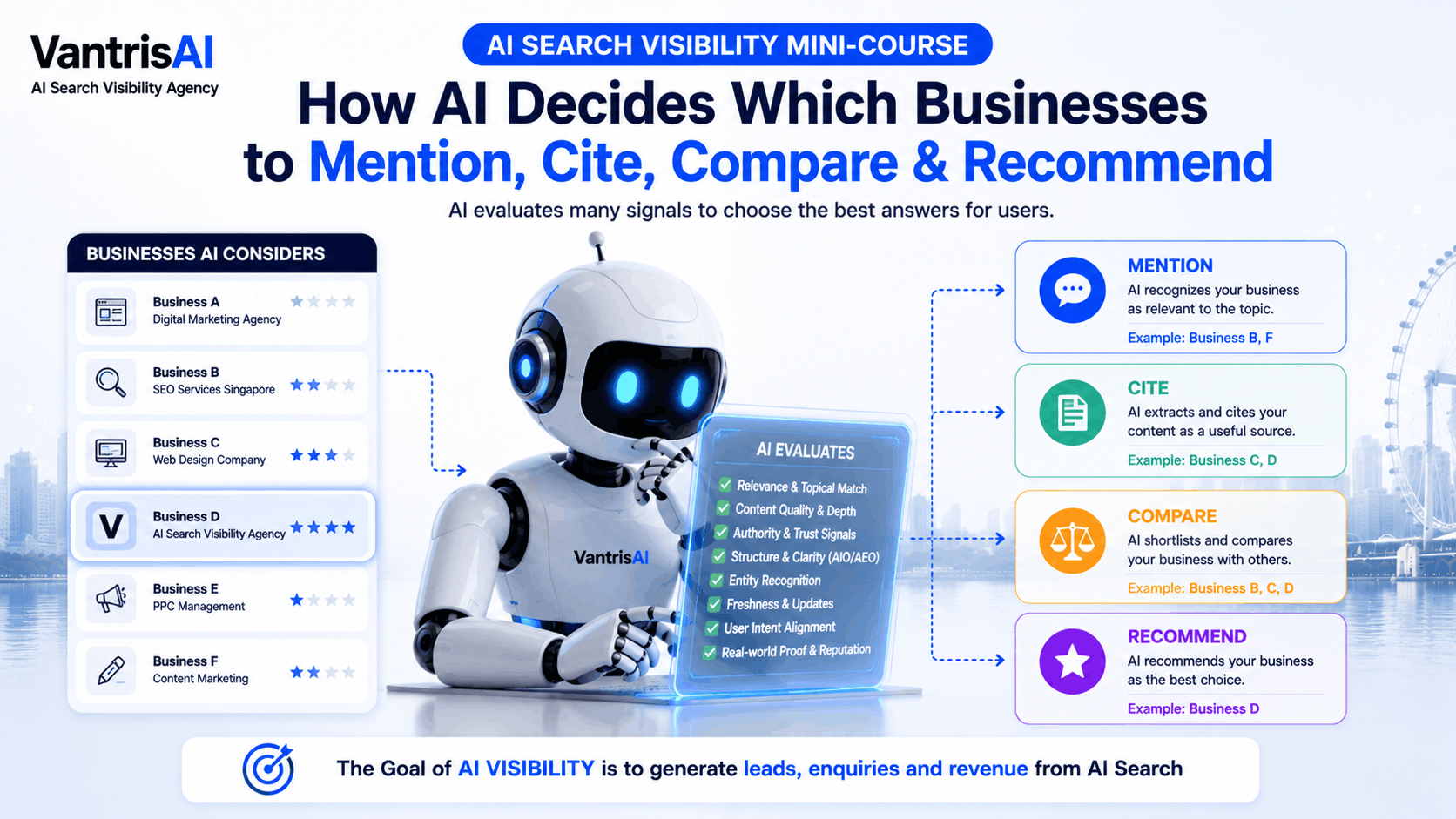
In the next lesson, we will explain how AI decides which businesses to mention, cite, compare, and recommend.
This is important because once you understand how AI selects businesses, you can start improving the parts of your website and online presence that influence AI inclusion.
Want to know whether AI can understand, cite, and recommend your business?
Run the VantrisAI AI Search Visibility Audit and check your score across AIO, AEO, and GEO.
Back to AI Search Visibility Mini-Course main page.
VantrisAI Case Study: where we use our own domain VantrisAI to get recommended by AI in 22 days.