Table of Contents
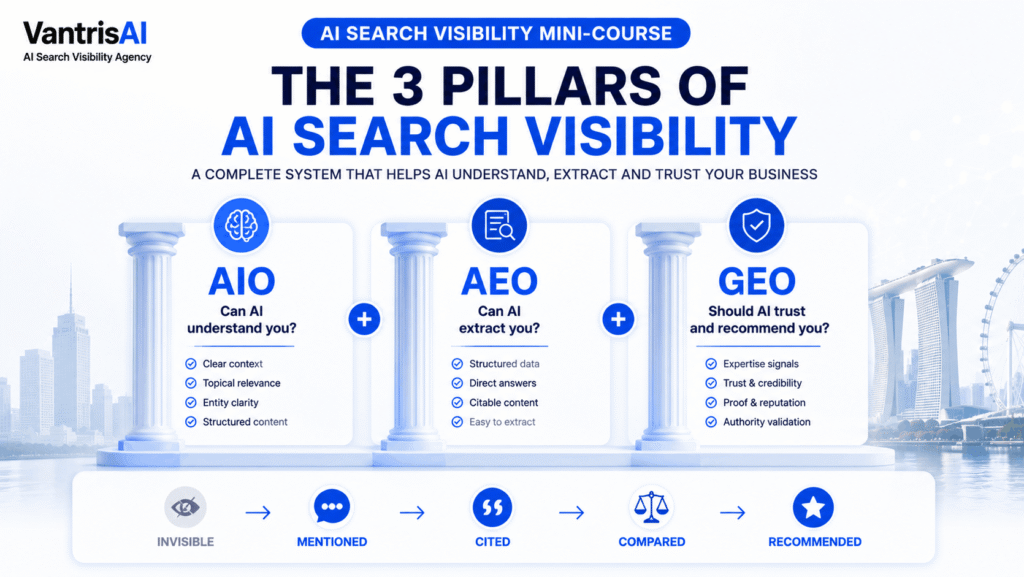
The 3 pillars of AI Search Visibility are AIO, AEO, GEO where AIO helps AI understand your business. AEO helps AI extract clear answers from your website. GEO helps AI trust, cite, compare, and recommend your business.
Together, these three pillars explain why some businesses appear in AI-generated answers while others are ignored. If AI does not understand your business, it may not mention you. If it cannot extract useful answers from your pages, it may not cite you. If it cannot find enough proof or trust signals, it may not recommend you.
A Simple AI Search Visibility System
Today, potential customers are not only searching on Google. They are asking AI tools such as ChatGPT, Gemini, Perplexity, Copilot, and Google AI features for explanations, comparisons, trusted providers, and recommendations.
This creates a new question for business owners:
“When buyers ask AI who they should consider, does AI understand, cite, compare, or recommend our business?”
That question is not easy to answer with traditional SEO metrics alone.
You may have a website, traffic and organic rankings. But AI may still ignore your business.
Why?
Because AI Search Visibility depends on more than having pages online. We have written what AI Search Visibility means at in our other mini-course.
AI needs to understand your business clearly and needs to extract useful answers from your content. They also need to find enough trust signals to include your business with confidence.
This is why VantrisAI uses a 3-pillar system:
- AIO: Can AI understand you?
- AEO: Can AI extract you?
- GEO: Should AI trust and include you?
These three pillars help business owners diagnose where the visibility problem is coming from.
The VantrisAI 3-Pillar System
VantrisAI uses three pillars to assess AI Search Visibility:
| Pillar | Meaning | Main Question | Business Impact |
|---|---|---|---|
| AIO | AI Overview Optimisation | Can AI understand your business? | Helps AI identify and mention you |
| AEO | Answer Engine Optimisation | Can AI extract useful answers from your website? | Helps AI cite and use your content |
| GEO | Generative Engine Optimisation | Should AI trust, compare, and recommend you? | Helps AI include you in commercial answers |
Each pillar has a different role. If one pillar is weak, the entire visibility journey can be blocked.
For example:
- If AIO is weak, AI may not understand what your business does.
- If AEO is weak, AI may not find clear answers to cite.
- If GEO is weak, AI may not trust your business enough to recommend it.
The goal is not to optimise one pillar in isolation but a connected AI visibility structure.
How the 3 Pillars Connect to the AI Visibility Ladder
In Article 2 ( how AI select which businesses to mention, cite, compare, and recommend), we explained the AI Selection Ladder:
- Invisible
- Mentioned
- Cited
- Compared
- Recommended
The 3 pillars support this ladder.
AIO helps move a business from invisible to mentioned.
AEO helps move a business from mentioned to cited.
GEO helps move a business from cited to compared and recommended.
This is important because different businesses are stuck at different stages.
Pillar 1: AIO – Can AI Understand Your Business?
AIO stands for AI Overview Optimisation.
At VantrisAI, AIO answers one main question:
“Can AI understand your business clearly enough to include it in relevant answers?”
This is the foundation of AI Search Visibility.
Before AI can cite, compare, or recommend your business, it must first understand what your business is.
AI needs to know:
- Your business name
- Your business category
- Your services
- Your target audience
- Your location or market
- Your main expertise
- Your positioning
- Your relationship to relevant topics
If these signals are unclear, AI may not know where your business fits.
This is why many good businesses remain invisible and we have seen it in our AI visibility audit.
They may be strong offline, have real clients, well establish but their website does not clearly explain the business in a way AI can understand. The goal is to remove ambiguity so AI does not guess what your business does.
Example of Weak AIO
A weak homepage might say:
“We help businesses grow with innovative digital solutions.”
This sounds professional, but it is not specific.
AI may struggle to understand:
- What type of solutions?
- For which businesses?
- In which country or market?
- What problem is solved?
- What service category does the company belong to?
- When should this company be recommended?
This type of copy may sound acceptable to a human visitor, but it does not give AI enough structured meaning.
Example of Strong AIO
A stronger version would say:
“VantrisAI helps Singapore business owners improve AI Search Visibility so tools like ChatGPT, Gemini, Perplexity, Copilot, and Google AI features can better understand, cite, compare, and recommend their business.”
This is clearer because it explains:
- The company: VantrisAI
- The audience: Singapore business owners
- The service category: AI Search Visibility
- The outcome: understand, cite, compare, recommend
- The relevant AI tools: ChatGPT, Gemini, Perplexity, Copilot, Google AI features
This gives AI a stronger entity profile.
The more clearly your website explains your business, the easier it becomes for AI to mention you in relevant answers.
We have create a audit tool that you can check you website AI Search Visibility score.
Pillar 2: AEO – Can AI Extract Useful Answers From Your Website?
AEO stands for Answer Engine Optimisation.
At VantrisAI, AEO answers one main question:
“Can AI extract useful answers from your website?”
This is the second pillar.
Once AI understands your business, it needs to find content that can support answers.
This is where many websites fail.
They may have information, but it is not structured in a way that AI can easily use.
The content may be too vague, too short, appear unclear or FAQs missing. Some client whom we work with have their service pages rewrite to better describe what buyers wants to know instead of what the company wants to say.
With that said, AEO improves your ability to be cited.
The goal of AEO is to make your content easy to extract.
AI should be able to take a useful answer from your page without needing to guess, infer, or search through unclear content.
Example of Weak AEO
A weak service page might say:
“Our team provides customised solutions designed to meet the needs of modern businesses. Contact us to learn more.”
This does not answer much.
It does not explain:
- What the service is
- Who it is for
- How it works
- What problems it solves
- What outcomes it supports
- Why the provider is credible
- What questions buyers commonly ask
This kind of page is hard for AI to cite.
Example of Strong AEO
A stronger service page would include:
- What the service is
- Who the service is for
- What problem it solves
- How the process works
- What is included
- What makes the service different
- Common buyer questions
- Case study or example
- Clear next step
For example:
“An AI Search Visibility Audit identifies whether AI tools can understand, cite, compare, and recommend your business. The audit reviews three pillars: AIO, AEO, and GEO. It helps business owners see whether their visibility issue comes from unclear positioning, poor answer extraction, or weak trust signals.”
This is easier for AI to extract.
Pillar 3: GEO – Should AI Trust, Compare, and Recommend Your Business?
GEO stands for Generative Engine Optimisation.
At VantrisAI, GEO answers one main question:
“Should AI trust and include your business in a generated answer?”
This is the third pillar.
GEO is about trust, authority, and proof.
A business can be clear and have pages that are structured. But if there is not enough evidence, AI may still hesitate to recommend it. Recommendation requires confidence. AI needs to see why your business is credible.
It needs to know whether your claims are supported.
It needs to see whether your business has proof, experience, external signals, or trust markers.
This is especially important for commercial and professional service queries.
When users ask AI for business recommendations, AI must decide which providers are safe and relevant to include.
GEO helps your business become more recommendable.
GEO looks at trust signals and typically includes the following,
- Case studies
- Testimonials
- Client results
- Reviews
- Founder or team credibility
- Author profiles
- External mentions
- Media references
- Directory consistency
- Partner or industry references
- Awards or certifications
- Clear contact information
- Business registration or legitimacy signals where relevant
- Consistent brand information across the web
- Strong About page
- Proof connected to service pages
The goal of GEO is to allow AI the reason why your business deserves to be included.
Example of Weak GEO
A weak trust structure might look like this:
- No case studies
- No testimonials
- No founder profile
- No examples of work
- No results
- No third-party mentions
- No clear business details
- No proof supporting claims
The website may say:
“We are trusted by clients.”
But there is no visible evidence.
This makes recommendation harder.
AI may understand the business and still avoid recommending it because the trust layer is thin.
Example of Strong GEO
A stronger trust structure would include:
- A founder note
- Case studies with specific outcomes
- Client testimonials
- Service-specific proof
- Screenshots or examples where appropriate
- Consistent company information
- External mentions or citations
- Educational content that demonstrates expertise
- Clear methodology
GEO is what helps AI move from understanding you to trusting you.
If AIO makes you mentionable and AEO makes you citable, GEO makes you more recommendable.
How AIO, AEO, and GEO Work Together
AIO, AEO, and GEO are not separate tactics, it is how to structure website pages for AI search.
Here is how they structured:
| Visibility Goal | Required Pillar | What AI Needs |
|---|---|---|
| To mention your business | AIO | Clear entity and category |
| To cite your content | AEO | Extractable answers |
| To compare your business | AIO + AEO + GEO | Clear positioning and useful information |
| To recommend your business | GEO | Trust signals and proof |
| To sustain visibility | All three | Consistency, structure, and authority |
This is why AI Search Visibility should not be treated as one checklist.
It is a system.
Example: Diagnosing a Business With the 3 Pillars
Imagine a Singapore professional services firm.
The firm has been around for 15 years.
It has good clients.
It gets referrals.
It has experienced directors.
But when someone asks AI for recommended providers in its category, the firm does not appear.
Here is how we might diagnose the issue.
AIO Review
Their homepage says:
“Your trusted partner for business success.”
This is vague. The service category is not obvious and the target audience is not clear.
While the have their office location, it is not strongly stated.
All this add up to AI may struggle to understand what the firm actually does.
Hence, AIO is weak.
AEO Review
Their service pages are short and they have only have a few paragraphs, no FAQs, no direct answer on their blog post and no process, framework or systems explanations.
With all these missing, AI may not be able to extract useful information from the pages.
The verdict is their AEO is weak.
GEO Review
The firm has many years of experience, but the website does not show case studies.
There are no testimonials.
The directors are not profiled.
There are no proof sections.
AI may not have enough evidence to trust or recommend the business.
So their GEO is weak.
Diagnosis
We advise the firm they need not publish random articles first, they need to repair its foundation.
First, clarify the homepage and service pages.
Second, make important pages answer-ready.
Third, add visible proof and trust signals.
By following the system, it tell us clearly what to fix first.
How the 3 Pillars Affect Commercial Outcomes
AI Search Visibility is not only a technical issue. It also affects commercial opportunity.
Each AI Search Visibility weakness affects a different part of the buyer journey.
- AIO affects discovery.
- AEO affects education.
- GEO affects trust and shortlist inclusion.
For business owners, this connects directly to:
- Opportunities
- Enquiries
- Sales conversations
- Client acquisition
- Revenue growth
- Market positioning
This is why the 3 pillars matter.
They are not vanity metrics and this also explain why businesses need AI search optimisation more now, so their business can be ready to be included in AI search.
Our audit tool show you how to improve AI search Visibility.
What to Fix First Then? A Simple Rule
If you are unsure where to start, use our audit tool to show you how to improve AI search Visibility.
Then use this rule,
- If AI cannot explain what you do, fix AIO.
- If AI can explain what you do but does not cite you, fix AEO.
- If AI cites you but does not recommend you, fix GEO.
This gives business owners a simple order of action.
Do not try to fix everything at once.
Fix the current pillar that has the lowest score.
Summary
By now, you know the 3 pillars of AI Search Visibility are AIO, AEO, and GEO.
- AIO helps AI understand your business.
- AEO helps AI extract useful answers from your website.
- GEO helps AI trust, compare, and recommend your business.
Together, these pillars explain why some businesses appear in AI-generated answers while others do not.
The goal is not to chase AI visibility randomly.
The goal is to diagnose the weakest pillar and fix the highest-leverage issue first. This creates a clearer path from invisible to mentioned, from mentioned to cited, from cited to compared, and from compared to recommended.
Next Lesson
In the next lesson, we will explain how to structure website pages so AI can understand and extract them.
This is where AIO and AEO become practical.
You will learn how a homepage, service page, article, or landing page should be structured so AI can identify the topic, extract the answer, and connect the page to your business.
Want to know whether your business has an AIO, AEO, or GEO problem?
Check Your AI Search Visibility Score to identify what is holding back your AI business visibility.
Learn from our own new domain on how VantrisAI improved from 51 to 92 in 22 days
Go to our AI Search Visibility Mini-Course Main Page.