Table of Contents
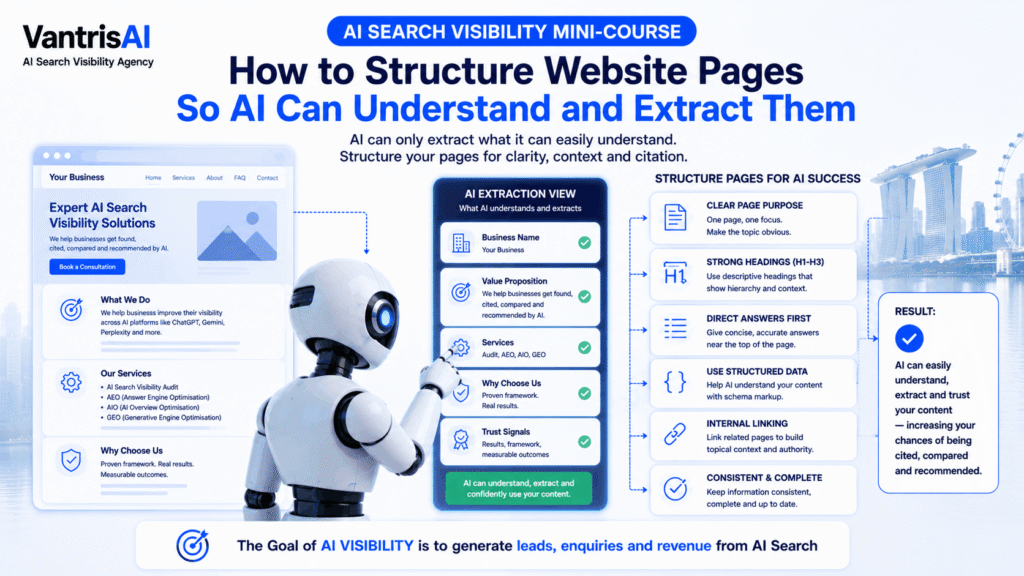
To structure a website page for AI search, make the page easy for AI to understand, extract, verify, and connect to your business.
A strong AI-ready page should include a clear direct answer near the top, a simple explanation of the topic, structured headings, service details, FAQs, proof, internal links, and a clear next step.
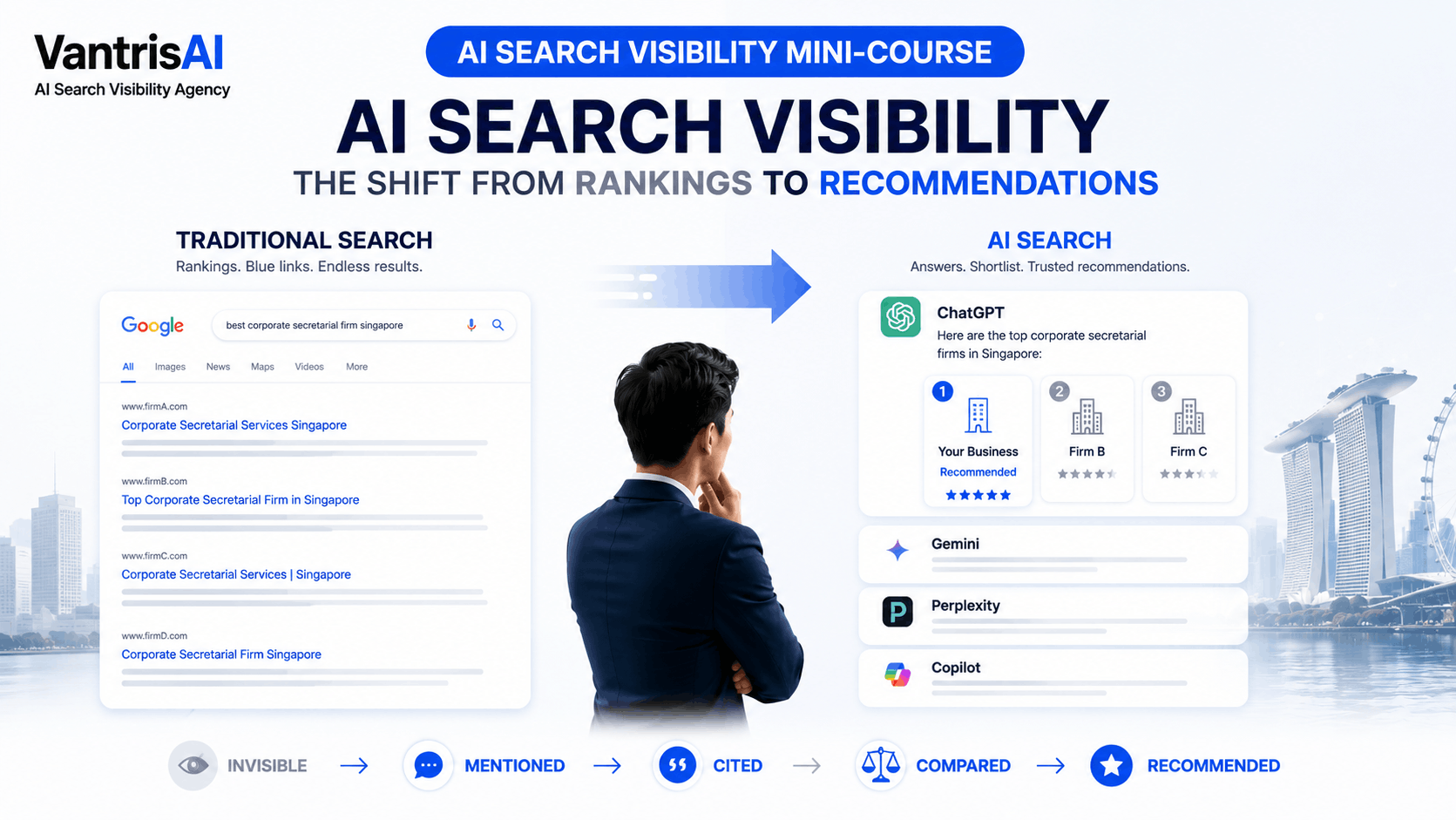
The goal is to make the page useful enough for AI tools such as ChatGPT, Gemini, Perplexity, Copilot, and Google AI features to understand what the page is about and use it in relevant answers.
For business owners, this means your website pages must be written for both humans and AI.
Why Page Structure Matters for AI Search Visibility
Most people think a website page only needs to look professional because design matters because human visitors need to trust what they see. But AI does not experience your website like a human visitor.
AI does not admire your layout nor they respond emotionally to your brand color or sleek animation. They also do not understand your business just because your homepage looks polished.
AI depends on meaning. It needs clear text, structured sections, useful answers, connected pages, and visible proof.
This is why many businesses with beautiful websites still struggle to appear in AI-generated answers. Their website may look good, but AI may not be able to clearly understand:
- What the business does
- Who the business serves
- What services are offered
- What problems are solved
- What makes the business credible
- What page should be cited
- When the business should be recommended
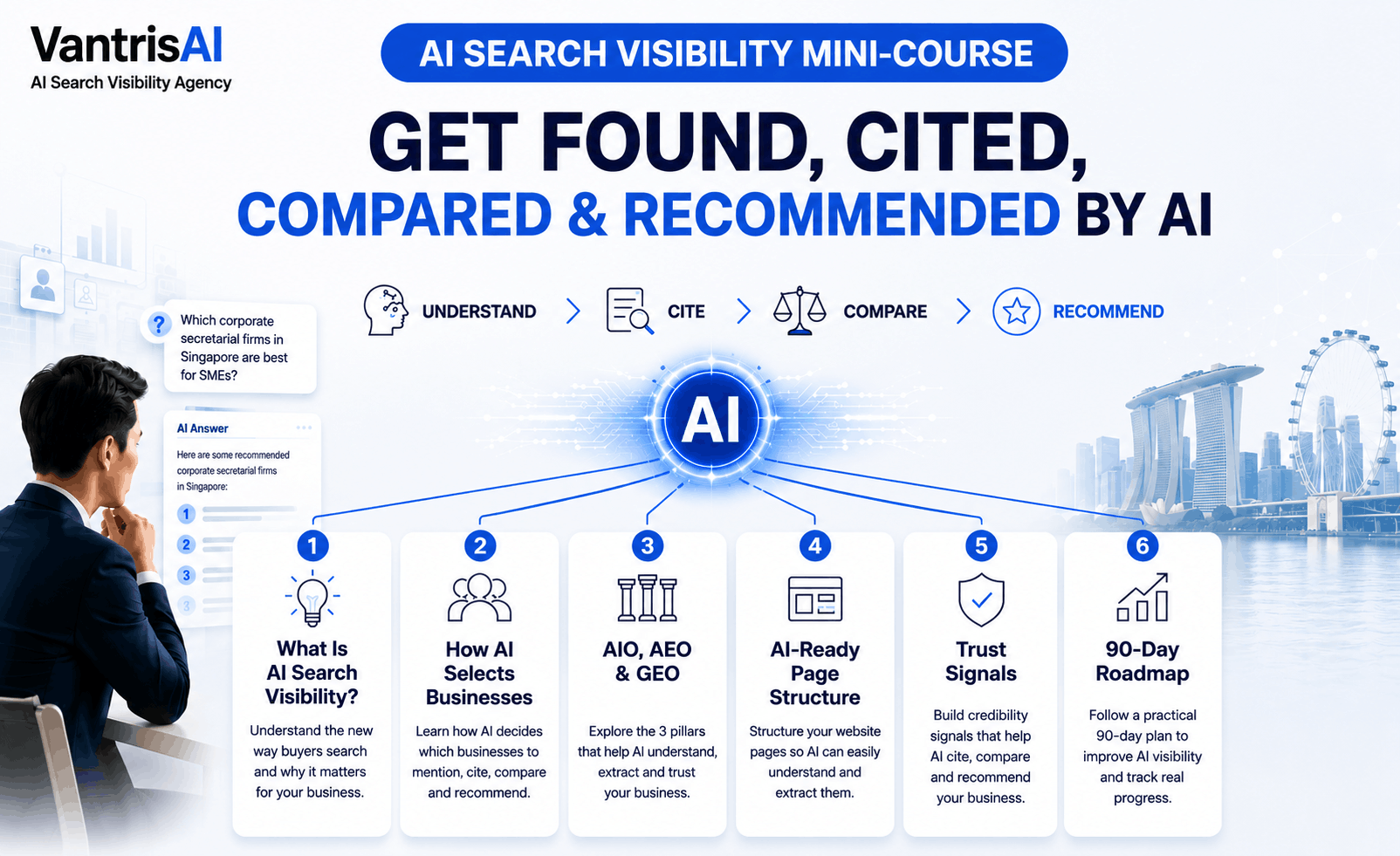
AI Search Visibility improves when your website becomes easier to read, easier to extract, and easier to trust. We have written a post on What is AI search visibility means that you can learn more from.
The Difference Between a Human-First Page and an AI-Ready Page
A human-first page often focuses on persuasion. It may use emotional headlines, short punchy copy, brand images, and visual flow. That can work well for conversion.
But for an AI-ready page needs something more. It must also provide structured meaning.
A human visitor may understand your business from context, visuals, and prior knowledge. AI needs more explicit signals.
For example, a human may see a corporate website and infer that the company provides accounting services. But AI needs the page to state clearly:
- The company is an accounting firm
- The firm serves Singapore SMEs
- The firm provides bookkeeping, tax, payroll, GST, and compliance services
- The firm is suitable for growing companies that need monthly accounting support
- The firm has proof, testimonials, or experience in the category
If the page does not say these things clearly, AI may not include the business in relevant answers. That is why AI-ready pages must balance human persuasion with machine readability. The best webpage does both.
How to Structure Website Pages For AI Search
Before AI can use a page in an answer, the page needs to help AI with four things on how AI selects businesses.
1. Understand the Topic
AI needs to know what the page or post is about. The topic should be clear from the:
- H1 title
- Opening paragraph
- Main headings
- Repeated terminology
- Internal links
- Page URL
- Metadata
- Supporting sections
If a page is about AI Search Visibility, it should clearly say that.
If a page is about corporate secretarial services, it should clearly say that.
If a page is about commercial litigation, it should clearly say that.
Do not hide the main topic behind clever copy.
2. Extract Useful Answers
AI tools often answer user questions directly. This means your page should contain answer-ready sections.
For example:
- What is this service?
- Who is it for?
- How does it work?
- What problem does it solve?
- What are the benefits?
- What should a buyer consider?
- Why should this provider be trusted?
If your page does not answer these questions clearly, AI may not extract anything useful from it.
A page that only says “Contact us to learn more” gives AI very little to use.
A page that explains the service clearly gives AI a reason to cite or include it.
3. Connect the Page to Your Business
AI needs to understand not only the topic, but also how the topic connects to your company.
For VantrisAI, an article about AI Search Visibility should connect back to:
- VantrisAI
- AIO
- AEO
- GEO
- AI Search Visibility audits
- Business owners
- Singapore businesses
- AI tools such as ChatGPT, Gemini, Perplexity, Copilot, and Google AI features
This helps AI understand that VantrisAI is not randomly writing about the topic.
It is part of the company’s core expertise. This applies for any business. A service page, blog article, case study, or landing page should strengthen the relationship between your business and the topic you want to be known for.
4. Verify the Claim
AI needs evidence. If your page says you are experienced, trusted, or effective, the page should support that claim.
Evidence can come in the form of:
- Case studies
- Testimonials
- Results
- Founder experience
- Team credentials
- Client examples
- External mentions
- Process details
- Screenshots
- Reviews
- Published research or data
Proof helps AI decide whether your page is only making a claim or actually supporting it. This is especially important for commercial queries. When buyers ask AI to recommend businesses, AI needs confidence. A page with strong proof gives AI more confidence than a page with generic claims.
The AI-Ready Page Structure
A strong AI-ready website page should follow a clear structure.
This does not mean every page must look identical.
But most important pages should include these core sections,
- H1 title
- Direct answer
- Business context
- Definition or clear explanation
- Who this is for
- Problem section
- Solution or service explanation
- How it works
- Use cases or examples
- Proof section
- Common mistakes
- FAQs
- Internal links
- Clear CTA (Call to action)
This structure helps both humans and AI.
Humans get clarity and confidence. AI gets meaning, extraction points, entity relationships, and proof.
Section 1: H1 Title
The H1 is the main title of the page.
It should clearly describe the topic.
A weak H1 might say:
“Unlock Your Digital Potential”
This sounds nice, but it does not explain the topic.
A stronger H1 would say:
“AI Search Visibility Audit for Singapore Businesses”
This is clearer because it tells AI and the reader:
- The service
- The market
- The audience
- The purpose
For AI search, the H1 should not be vague.
It should identify the main topic as clearly as possible.
Section 2: Direct Answer
The direct answer should appear near the top of the page.
This section answers the main question immediately.
For example, on a page about AI Search Visibility, the direct answer could be:
“AI Search Visibility is the ability of your business to be understood, cited, compared, and recommended by AI tools when buyers ask questions related to your products, services, industry, or location.”
This helps AI understand the page quickly.
It also helps human readers.
Most buyers do not want to work hard to understand your page.
They want clarity.
A direct answer gives them that clarity early.
Section 3: Business Context
After the direct answer, explain why the topic matters commercially.
For VantrisAI, this means connecting the topic to:
- Opportunities
- Clients
- Revenue
- Growth
- Buyer shortlists
- AI-generated recommendations
For example:
“AI Search Visibility matters because buyers are no longer only searching on Google. They are asking AI tools for recommendations, comparisons, and trusted providers. If your business is not included in those answers, you may lose opportunities before the buyer visits your website.”
This turns the topic from a technical concept into a business issue.
Section 4: Definition or Clear Explanation
Every important page should define the main concept clearly.
If the page is about AEO, define AEO.
If the page is about GEO, define GEO.
If the page is about corporate tax filing, explain what corporate tax filing means.
Do not assume the reader or AI already understands.
Definitions help AI extract clean answers.
They also help the page become more useful for informational queries.
A strong definition should be:
- Simple
- Specific
- Direct
- Relevant to the target audience
- Connected to the business context
For example:
“Answer Engine Optimisation, or AEO, is the process of structuring website content so AI tools and search engines can extract clear answers from your pages.”
This is simple and useful.
Section 5: Who This Is For
AI often needs to match a business to a specific type of user.
That is why pages should explain who the service, solution, or topic is for.
For example:
“This guide is for business owners, founders, and professional service firms that want to understand why AI tools mention competitors but not their business.”
This gives AI context.
It helps AI know when to recommend the page or business.
For service pages, this section can be even more specific:
“This service is suitable for Singapore SMEs, B2B suppliers, professional service firms, and founder-led businesses that want to improve how they appear in AI-generated answers.”
The clearer the audience, the easier the match.
Section 6: The Problem Section
A strong page explains the problem before introducing the solution.
This helps both humans and AI understand the reason the page exists.
For example:
“Many businesses have strong real-world credibility, but weak AI-visible credibility. Their website may not explain their services clearly, their proof may be hidden, and their content may not answer buyer questions directly. As a result, AI tools may mention competitors instead.”
This problem section gives context.
It explains the gap.
It helps AI understand what pain point the business solves.
Without a problem section, the page may feel like a service description without relevance.
Section 7: The Solution or Service Explanation
After the problem, explain the solution clearly.
For a service page, this means explaining what the service does.
For an article, this means explaining the framework or method.
For example:
“VantrisAI improves AI Search Visibility by diagnosing three pillars: AIO, AEO, and GEO. AIO helps AI understand the business. AEO helps AI extract answers from the website. GEO helps AI trust, compare, and recommend the business.”
This is clear.
It explains the method and connect the solution to the problem.
It also reinforces important entities and terms.
Section 8: How It Works
AI-ready pages should explain process.
A process helps AI and humans understand what actually happens.
For example:
- Diagnose current AI Search Visibility
- Identify AIO, AEO, and GEO gaps
- Fix website structure and content clarity
- Add answer-ready sections and FAQs
- Strengthen proof and trust signals
- Monitor mentions, citations, comparisons, and recommendations
This makes the service easier to understand.
It also helps AI extract steps.
A process section is useful because AI often answers “how” questions. If your page explains the process clearly, it becomes more usable in AI-generated answers.
Section 9: Use Cases or Examples
Use cases help AI understand when your business is relevant.
They also help AI match your business to user intent.
If someone asks AI:
“Why does ChatGPT mention my competitor but not my company?”
A page with that use case becomes more relevant.
Section 10: Proof Section
A proof section helps AI trust the page.
For business owners, this is one of the most important sections.
Proof may include:
- Case study summaries
- Before-and-after results
- Testimonials
- Screenshots
- Client examples
- Research findings
- Founder experience
- Published frameworks
- External references
Proof should not be hidden only on one case study page. It should be connected to relevant service pages and articles.
This helps AI understand that your claims are supported across the site.
Section 11: Common Mistakes
Common mistake sections are useful for both readers and AI.
They help explain what not to do.
They also capture related search intent.
For AI-ready page structure, common mistakes include:
- Using vague headlines
- Hiding important text in images
- Having thin service pages
- Not answering the main question early
- Not using clear headings
- Not defining important terms
- Not adding FAQs
- Not showing proof
- Not linking related pages
- Not explaining who the page is for
- Not making the business category clear
- Not connecting articles to service pages
A mistake section helps the reader self-diagnose.
It also makes the page more complete.
Section 12: FAQs
FAQs are important because AI tools are often answering questions.
A good FAQ section should not be added only for appearance.
It should answer real buyer questions.
Examples:
What is an AI-ready website page?
An AI-ready website page is a page structured so AI tools can understand the topic, extract useful answers, connect the page to the business, and verify the claims with supporting evidence.
Does every page need to be long?
No. Every page does not need to be long. But important pages should be complete enough to explain the topic, answer buyer questions, show proof, and guide the next step.
Should I write for AI or humans?
You should write for both. The page should be clear and useful for human visitors while also being structured enough for AI systems to understand and extract.
Do FAQs help AI Search Visibility?
FAQs can help if they answer real questions clearly. Generic FAQs do not help much. The questions should reflect what buyers actually ask before making a decision.
Section 13: Internal Links
Internal links help AI understand how your pages connect.
A single page is useful. A connected content network is stronger.
For VantrisAI, this article should link to:
- What Is AI Search Visibility?
- How AI Decides Which Businesses to Mention, Cite, Compare, and Recommend
- The 3 Pillars of AI Search Visibility
- How to Build Trust Signals That Help AI Cite and Recommend Your Business
- The 90-Day AI Search Visibility Roadmap
- AI Search Visibility Audit
- VantrisAI case study
Internal links create topical relationships.
They show AI that the website covers the subject in depth.
They also guide human readers through the mini-course.
Section 14: Clear CTA
Every important page should have a clear next step.
For VantrisAI, the best CTA is:
“Check Your AI Search Visibility Score.”
This is better than a generic CTA such as:
“Contact us today.”
Why?
Because it matches the reader’s current awareness.
If the reader is learning about AI Search Visibility, the natural next question is:
“How visible is my business right now?”
The audit answers that question.
A good CTA should continue the buyer journey, not interrupt it.
Example: Weak Page vs AI-Ready Page
To understand the difference, compare these two examples.
Weak Page
Title:
“Grow With Confidence”
Opening copy:
“We provide innovative, customised solutions to help businesses succeed in today’s fast-changing digital world. Our experienced team is committed to delivering quality service and measurable results.”
Problem:
This copy sounds professional, but it does not explain enough.
AI cannot clearly identify:
- What service is offered
- Who the business serves
- What problem is solved
- What market is targeted
- What proof supports the claim
- When the business should be recommended
This page may look polished, but it is weak for AI extraction.
AI-Ready Page
Title:
“AI Search Visibility Audit for Singapore Business Owners”
Opening copy:
“An AI Search Visibility Audit checks whether AI tools such as ChatGPT, Gemini, Perplexity, Copilot, and Google AI features can understand, cite, compare, and recommend your business. The audit reviews three pillars: AIO, AEO, and GEO, then identifies the first fix most likely to improve your AI visibility.”
Why this is stronger:
- The service is clear
- The audience is clear
- The AI tools are named
- The outcome is clear
- The method is explained
- The page connects to AIO, AEO, and GEO
- The reader knows what happens next
This is much easier for AI and humans to understand.
How to Structure a Homepage for AI
Your homepage is one of the most important AI understanding pages.
It should quickly answer:
- Who are you?
- What do you do?
- Who do you help?
- What outcome do you create?
- Why should someone trust you?
- What should the visitor do next?
A strong homepage structure may look like this:
- Clear headline
- Direct explanation
- Who you help
- Problem you solve
- Your system or method
- Services or key offers
- Proof or case study
- Testimonials
- Educational links
- CTA
For VantrisAI, the homepage should make it obvious that the company helps business owners improve AI Search Visibility through AIO, AEO, and GEO.
The homepage should not only sound impressive.
It should make the business understandable.
How to Structure a Service Page for AI
A service page should be specific. It should not be a thin page with vague claims. A strong service page structure may look like this:
- Service name
- Direct answer explaining the service
- Who the service is for
- Problem the service solves
- What is included
- How the process works
- Expected outcome
- Proof
- FAQs
- CTA
How to Structure a Blog Article for AI
A blog article should not be written only as an opinion piece.
It should answer a specific topic clearly.
A strong blog structure may look like this:
- H1 title
- Direct answer
- Why the topic matters
- Definition
- Main explanation
- Examples
- Framework or checklist
- Common mistakes
- FAQs
- Summary
- Internal links
- CTA
Each article answers one core question.
Together, the articles build topical authority around AI Search Visibility.
This helps AI understand that VantrisAI is associated with the topic in a deep and structured way.
How to Structure a Case Study for AI
A case study is important for GEO because it provides proof.
A strong case study structure may look like this:
- Client or business type
- Starting problem
- Initial AI visibility state
- What was fixed
- Timeline
- Result
- Commercial impact
- What this proves
- Related service link
- CTA
For example:
“VantrisAI started with a score of 51. After fixing the structure, the score improved to 92 in 22 days, and AI began citing the website.”
This type of proof is useful because it is specific.
It gives AI evidence.
It also gives business owners confidence.
What Business Owners Should Fix First
If your website is not AI-ready, do not try to fix everything at once.
Start with the pages that matter most commercially.
The priority should usually be:
- Homepage
- Main service pages
- About page
- Case study pages
- FAQ sections
- Educational articles
- Internal links
- External trust signals
Your homepage helps AI understand who you are.
Your service pages help AI understand what you provide.
Your About page helps AI understand credibility.
Your case studies help AI trust your claims.
Your educational articles help AI connect your business to important topics.
Together, these pages form your AI visibility foundation.
Learn how VantrisAI improved from 51 to 92 in 22 days in the AI Search Visibility journey
Summary
AI-ready page structure is not about writing for robots and is from one of the 3 pillars of AI Search Visibility where it is all about making your business easier to understand. A strong page helps AI and human readers answer four questions,
- What is this page about?
- What useful answer can be extracted?
- How does this connect to the business?
- What proof supports the claim?
If your website pages are vague, thin, disconnected, or unsupported by proof, AI may ignore them. But when your pages are clear, structured, connected, and evidence-backed, AI has a better chance of understanding, citing, comparing, and recommending your business.
Next Lesson
In the next lesson, we will explain how to build trust signals that help AI cite and recommend your business. This is where GEO becomes practical. You will learn what proof AI may look for, why case studies matter, how third-party signals support trust, and why business owners need to make credibility visible online.
Want to know whether your website pages are structured for AI understanding and extraction?
Run the VantrisAI AI Search Visibility Audit and check your AI Search Visibility Score. The audit helps identify whether your website has a clarity problem, an extraction problem, or a trust problem, so you know what to fix first.
Article URL:
/structure-website-pages-for-ai-search/
Article Keyword:
Structure website pages for AI search
Secondary Keywords:
- AI-ready website structure
- How to structure content for AI search
- Website structure for ChatGPT
- Website structure for Gemini
- AI Search Visibility
- Answer Engine Optimisation
- AI content extraction
- AI-readable website pages
- Service page structure for AI
- AI search optimisation for business owners
Article Meta Description:
Learn how to structure website pages so AI tools like ChatGPT, Gemini, Perplexity, Copilot, and Google AI features can understand, extract, cite, and recommend your business.
Click or tap to goto AI Search Visibility Mini-Course main page.