Table of Contents
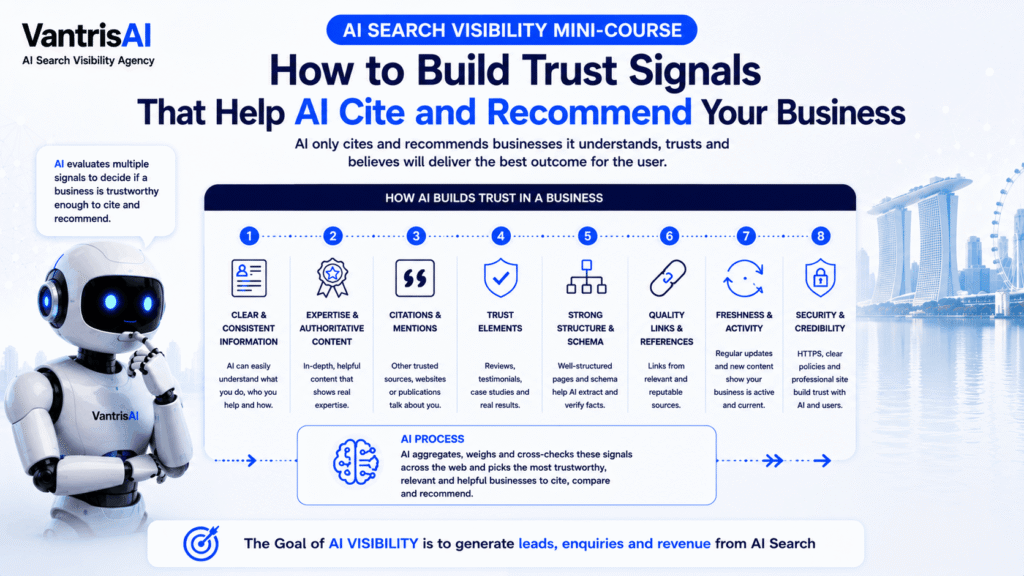
To help AI cite and recommend your business, you need visible AI search trust signals that prove your business is real, relevant, experienced, and credible.
AI tools such as ChatGPT, Gemini, Perplexity, Copilot, and Google AI features do not rely only on what you claim about yourself. They look for supporting evidence across your website and the wider web. This can include case studies, testimonials, founder credibility, client results, reviews, external mentions, consistent business information, and educational content that demonstrates expertise.
For business owners, trust signals help move your business from being merely visible to being citable, comparable, and recommendable.
If you are new to this topic, start with the AI Search Visibility Mini-Course to understand how AI discovery works across the full visibility journey.
Why AI Search Trust Signals Matter in AI Era
AI search is not only about being found. It is about being trusted enough to be included in an answer.
That difference matters.
A business can have a website, publish articles, and describe its services clearly. But when a buyer asks AI for a recommendation, AI has to decide which businesses are relevant, credible, and supportable.
This is especially important for commercial searches.
For example, a buyer may ask:
- “Which law firm should I consider for commercial contracts in Singapore?”
- “Which corporate secretarial firm is suitable for SMEs?”
- “Who can help my business improve AI Search Visibility?”
- “Which B2B supplier is reliable for automotive spare parts?”
- “Which accounting firm is suitable for startups?”
In these situations, AI cannot list every company. It has to shortlist or recommend.
If your website has claims but no proof, AI may understand what you do but still hesitate to include you. If your competitors have clearer case studies, reviews, testimonials, external mentions, and business information, AI may feel more confident surfacing them instead.
This does not always mean they are better, it may mean they are easier for AI to trust.
To understand the earlier stage of this process, read how AI decides which businesses to mention, cite, compare, and recommend .
Visibility Is Not the Same as Trust
Being visible means AI can find or recognise your business.
Being trusted means AI has enough supporting information to include your business in a useful answer.
These are not the same.
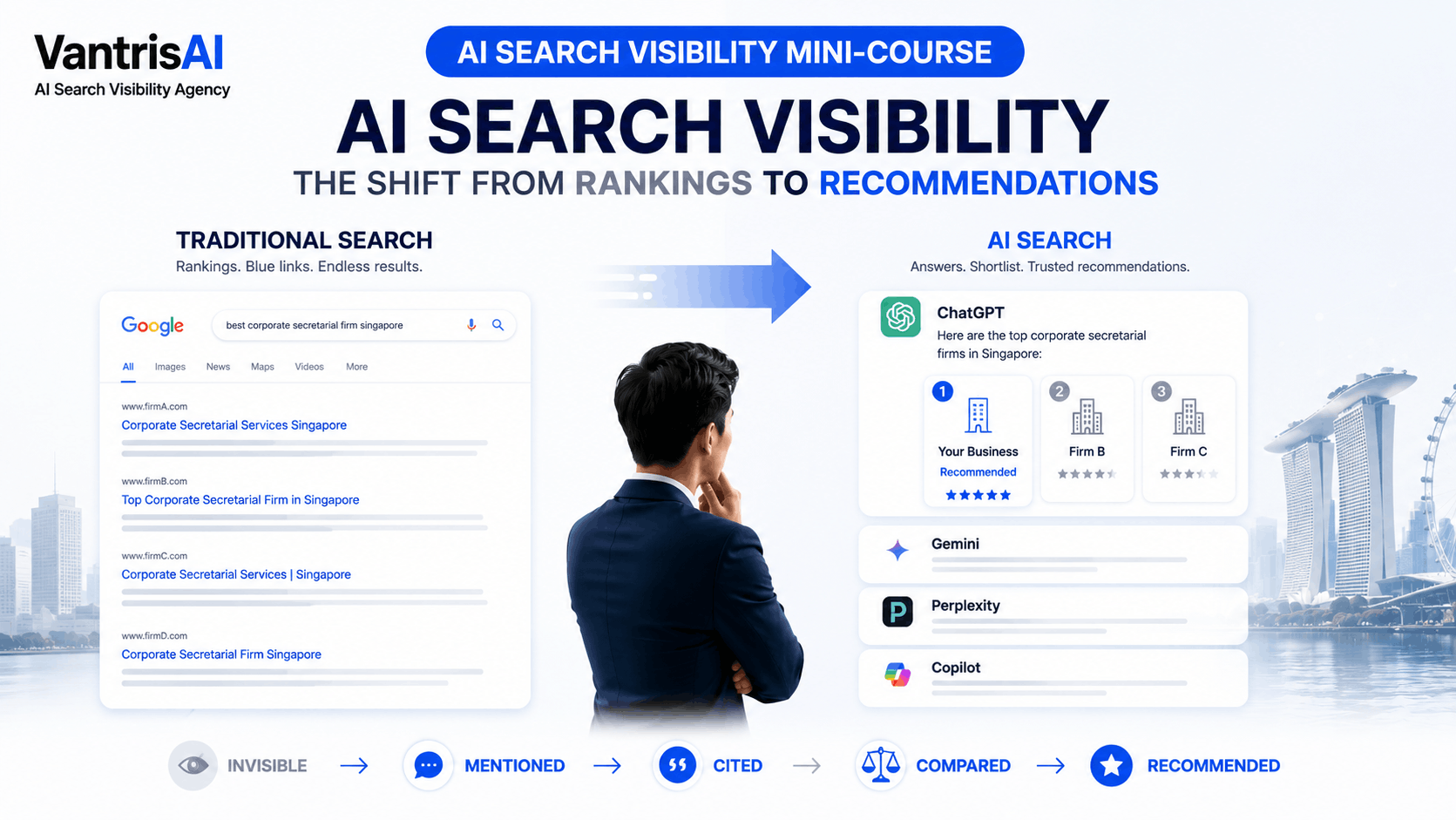
AI visibility usually develops in stages:
- Invisible
- Mentioned
- Cited
- Compared
- Recommended
Each stage requires more confidence from AI.
To be mentioned, AI needs to know you exist.
To be cited, AI needs useful content from your website.
To be compared, AI needs to understand your positioning.
To be recommended, AI needs enough proof to justify why your business belongs in the answer.
That is where AI search trust signals become important.
If you have not read the foundation lesson yet, go back to what AI Search Visibility means before going deeper into trust signals.
What Are Trust Signals?
Trust signals are pieces of evidence that help AI and human buyers believe your business is credible.
They reduce uncertainty, support your claims, and clarify why your business should be included in a recommendation or comparison. Trust signals can appear on your own website, across external platforms, and within the wider internet.
Examples include:
- Case studies
- Client testimonials
- Reviews
- Founder or team profiles
- Years of experience
- Client results
- Screenshots
- Before-and-after examples
- Industry references
- Awards
- Certifications
- Media mentions
- Partner mentions
- Directory listings
- Consistent business information
- Helpful educational content
- Clear methodology
- Published research
- Strong About page
- Clear contact information
These are part of the AI search trust signals layer that helps AI decide whether your business should be cited, compared, or recommended.
How AI Search Trust Signals Support GEO
Trust signals are closely connected to GEO (Generative Engine Optimisation).
GEO answers the question:
“Should AI trust, compare, and recommend your business?”
Without GEO, your business may remain stuck or invisible.
AI may understand what you do.
It may even cite your content or website but may still avoid recommending you because the proof layer is too weak.
This is why GEO matters.
It is the bridge between being known and being trusted.
To see how GEO fits with the full system, read the 3 pillars of AI Search Visibility .
Why AI Needs Evidence Before Recommendation
When AI gives a recommendation, it needs a reason. It cannot simply say your business is suitable because your website says so. It needs supporting signals that make the recommendation defensible.
Compare these two statements.
Weak claim:
“We are a trusted business consulting company.”
Stronger claim:
“We help Singapore SMEs improve operational efficiency through a 3-step consulting process: business diagnosis, workflow redesign, and implementation support. In one client project, a service-based SME reduced manual reporting time by 40% within 60 days after restructuring its internal workflow.”
The second version gives AI more to work with.
It includes:
- Business category
- Market
- Audience
- Service method
- Proof
- Specific result
- Timeline
AI can do more with evidence than with adjectives.
That is why business owners should avoid relying only on phrases like:
- Trusted provider
- Leading company
- Best service
- Professional team
- Reliable partner
- One-stop solution
- Customer-first approach
- One stop shop
- One stop solution
These phrases though sound positive, but they do not prove much. A better approach is to make your proof specific, visible, and easy to extract.
First-Party Trust Signals
These are usually the fastest to improve because you do not need to wait for media coverage, third-party mentions, or external publications as they appear on you own website.
Important first-party trust signals include:
- Case studies
- Testimonials
- Founder or team credibility
- About page
- Service-page proof
- Clear methodology
- Client examples
- Results and timelines
- FAQs
- Contact and business details
Let’s go through each one.
1. Case Studies
Case studies are one of the strongest AI search trust signals.
A case study shows that your business has solved a real problem. It gives AI a structured example of what you do, who you help, and what outcome you created.
A strong case study should include:
- The starting problem
- The business type or industry
- The starting visibility state
- What was fixed
- The method used
- The timeline
- The result
- The commercial impact
- What the case proves
For example, instead of saying:
“We helped a client improve online visibility.”
A stronger case study summary would say:
“A Singapore-based B2B supplier was not being mentioned by AI tools for relevant buyer queries. After restructuring its service pages, FAQs, and proof sections, the business began receiving AI referral traffic and qualified enquiries within six weeks.”
This is stronger because it shows:
- Business type
- Original problem
- Action taken
- Timeline
- Outcome
- Commercial relevance
Case studies help AI understand why a business should be trusted. They also help human buyers believe the business can deliver.
2. Testimonials
Testimonials or case studies that show that other people have experienced value from your business.
But not all testimonials or case studies are equal.
A weak testimonial says:
“Great service. Highly recommended.”
This is positive, but not very useful.
A stronger testimonial says:
“The team helped us understand why our business was not appearing in AI-generated recommendations. After improving our page structure, service explanations, and proof sections, we started seeing more qualified enquiries from high-intent visitors.”
This is stronger because it explains:
- The original problem
- What was done
- The result
- Why the service mattered
When collecting testimonials or write case studies, ask clients to mention context as this is also another AI Search trust signals that AI wants to see.
3. Founder or Team Credibility
Like human, AI needs to understand who is behind the business. This is especially important for professional services, consulting, legal, accounting, finance, medical, B2B, and advisory businesses.
A faceless website may look less credible.
A strong founder or team section helps establish:
- Experience
- Expertise
- Industry relevance
- Perspective
- Methodology
- Accountability
For example, a founder note may say:
“I started this company after working with over 80 SME owners and seeing the same problem repeatedly: many businesses had strong expertise but weak online proof. Our work focuses on helping companies explain their value clearly, structure their service pages properly, and build the trust signals needed for buyers to shortlist them.”
This kind of note is useful because it adds:
- Origin story
- Experience
- Clear audience
- Business belief
- Founder accountability
AI can use these signals to understand authority. Human buyers can use them to build trust.
4. About Page
The About page is often underestimated and under-valued. Many businesses write a weak About page because they think buyers do not read it. But for AI search, the About page can be an important entity page.
It helps AI understand:
- Who the business is
- What category it belongs to
- Who it serves
- Where it operates
- Why it exists
- What experience it has
- What makes it credible
- What topics it should be associated with
A weak About page says:
“We are passionate about helping clients succeed.”
A stronger About page says:
“We are a Singapore-based business consulting firm helping SMEs improve operational clarity, service positioning, and customer acquisition. Our work combines business diagnosis, website structure, and proof-building so buyers can understand what the company does and why it should be trusted.”
That is clearer.
It gives AI useful entity information. Your About page should not only tell a brand story. It should clarify your business identity.
5. Service-Page Proof
Many businesses keep proof only on a separate testimonial or case study page.
That is a mistake.
Your most important service pages should include relevant proof.
If a page is about corporate secretarial services, it should include proof of experience in that area.
If a page is about commercial law, it should include relevant credentials, experience, or case examples where appropriate.
Service-page proof can include:
- Short case study blocks
- Testimonials
- Result snippets
- Client-type examples
- Process evidence
- Screenshots
- Before-and-after examples
- Links to full case studies
This helps AI connect the service to evidence. It also helps buyers make decisions faster.
To make this proof easier for AI to extract, your service pages should follow a clear structure. You can use how to structure website pages for AI search as the companion lesson.
6. Clear Methodology
A clear methodology is a trust signal because it shows that your business has a structured way of solving problems.
For AI Search Visibility, the methodology can be explained through three layers:
- AIO: Can AI understand your business?
- AEO: Can AI extract useful answers from your website?
- GEO: Should AI trust, compare, and recommend you?
This is better than saying:
“We help improve your AI visibility.”
The 3-pillar system shows how the work is diagnosed. It gives AI and buyers a repeatable structure.
For other businesses, methodology could include:
- A legal review process
- An accounting onboarding process
- A consulting framework
- A product sourcing process
- A project delivery system
- A risk assessment method
- A customer success process
Methodology helps AI understand how your business creates outcomes. It also separates you from generic providers.
7. Client Examples
Client examples help AI understand who you serve.
They do not always need to reveal client names. Anonymous examples can still be useful if they are specific enough.
For example:
“A Singapore B2B automotive spare parts supplier with over 1,000 SKUs wanted to improve AI visibility and create enquiries through AI search, not just increase rankings.”
This tells AI the industry, market, business type, problem, and objective.
Client examples are especially useful for B2B companies because buyers often want to know whether you understand their type of business.
If you serve professional service firms, say so.
If you serve SMEs, say so.
If you serve B2B suppliers, say so.
If you serve founder-led companies, say so.
Clear client examples help AI match your business to the right buyer queries.
8. Results and Timelines
Specific results are another AI Search trust signals for search and getting specific is stronger than general claims.
A weak result says:
“We helped improve visibility.”
A stronger result says:
“After restructuring key service pages and proof sections, the business started receiving qualified enquiries from AI referral traffic within six weeks.”
Another stronger result says:
“The company reduced manual reporting time by 40% within 60 days after redesigning its internal workflow and management dashboard.”
Results and timelines are useful because they make proof more concrete.
Where possible, include:
- Starting point
- Action taken
- Timeline
- Outcome
- Commercial impact
Not every result needs to be dramatic. It just needs to be specific and truthful.
9. FAQs
FAQs are usually discussed under AEO because they help AI extract answers. But they also support trust. A strong FAQ section shows that your business understands buyer concerns. For AI Search Visibility, useful trust-building FAQs may include:
- Can AI Search Visibility be guaranteed?
- How long does it take to see AI mentions?
- Is this the same as SEO?
- What happens after the audit?
- Why does AI mention competitors but not us?
- What proof do we need to become recommendable?
- Do service businesses need AI Search Visibility?
These questions help remove doubt. They also show that the business is willing to explain complexity clearly. A trustworthy business educates buyers before asking them to enquire.
10. Clear Contact and Business Details
Basic business information is still important.
AI and human buyers need to know that your business is real.
Your website should clearly show:
- Business name
- Location or market
- Contact method
- Business email
- Phone or WhatsApp where appropriate
- Company registration details where relevant
- Social profiles
- Founder or team identity
- Service area
For businesses, consistency across your website, Google Business Profile, LinkedIn, directories, and public profiles can help reinforce trust.
Third-Party Trust Signals
Third-party trust signals appear outside your own website.
They are powerful because they do not come directly from you. They help AI and buyers verify that your business exists beyond your own claims.
Examples include:
- Media mentions
- Directory listings
- Review platforms
- Partner websites
- Podcast appearances
- Event pages
- Industry references
- LinkedIn profiles
- Google Business Profile
- Publications
- Awards
- Guest articles
- External case studies
- Public interviews
Third-party signals are especially useful for GEO because they show that your business is recognised beyond its own domain.
Why External Mentions Matter
External mentions is another helpful AI Search trust signals that help AI understand what others say about you. If your own website says you are credible, that is one signa and if external sources also mention your business in a consistent and relevant way, your entity becomes easier to understand and trust.
External mentions can help AI identify:
- Your business category
- Your location
- Your founder
- Your services
- Your reputation
- Your industry involvement
- Your relevance to a topic
For a service business, useful AI Search trust signals could include:
- Mentions in business or industry publications
- Interviews with the founder
- Directory profiles
- LinkedIn content
- Client mentions
- Partner references
- Guest articles
- Citations of original research or reports
Third-party signals do not need to be massive media coverage. They need to be consistent, relevant, and credible.
Consistency Across the Web
AI may see information from multiple sources. If those sources say different things, trust becomes weaker.
Consistency helps AI understand your entity.
Your business information should be aligned across:
- Website
- Google Business Profile
- LinkedIn page
- Founder LinkedIn profile
- Directory listings
- Review platforms
- Partner pages
- Media profiles
- Business databases
- Social profiles
For an AI Search Visibility business, the key category should remain consistent.
The language should reinforce:
- AI Search Visibility
- AIO
- AEO
- GEO
- Business owners
- Target market
- AI tools such as ChatGPT, Gemini, Perplexity, Copilot, and Google AI features
Consistency builds entity strength.
What Trust Signals AI May Use for Different Visibility Stages
Different visibility stages require different trust levels.
| Visibility Stage | What AI Needs | Trust Signal Required |
|---|---|---|
| Mentioned | AI knows the business exists | Basic business clarity |
| Cited | AI can use the content | Structured answers and useful pages |
| Compared | AI understands the positioning | Clear differentiation and use cases |
| Recommended | AI has confidence to include the business | Proof, authority, and external validation |
Summary
Trust signals help AI decide whether your business should be cited, compared, or recommended. AI does not only need to know that your business exists. It needs enough evidence to understand why your business is credible. In an AI Search Visibility system, trust signals are part of GEO: Generative Engine Optimisation.
Remember that if AI mentions your business but does not recommend it, your trust layer may be too weak. The solution is to make your proof clearer, more specific, and easier for AI to find.
Next Lesson
In the next lesson, we will explain the 90-Day AI Search Visibility Roadmap for business owners.
You will see how to move from diagnosis to action across AIO, AEO, and GEO, and how to prioritize the fixes most likely to improve AI visibility over 90 days.
Want to know whether your business has enough trust signals for AI to cite and recommend you? Run an AI Search Visibility Audit and check your AIO, AEO, and GEO score. The audit helps identify whether your business has a clarity problem, an extraction problem, or a trust problem, so you know what to fix first.
Start your audit here > Check Your AI Search Visibility Score.