Table of Contents
A 90-day AI Search Visibility roadmap helps business owners improve the probability that AI tools such as ChatGPT, Gemini, Perplexity, Copilot, and Google AI features can understand, cite, compare, and recommend their business.
The goal is not to publish random content or chase another marketing trend. The goal is to make your business clearer, more extractable, more credible, and easier for AI to include in relevant buyer conversations.
If you are new to this topic, start with the AI Search Visibility Mini-Course .
What This 90-Day AI Search Visibility Roadmap Is Designed to Do
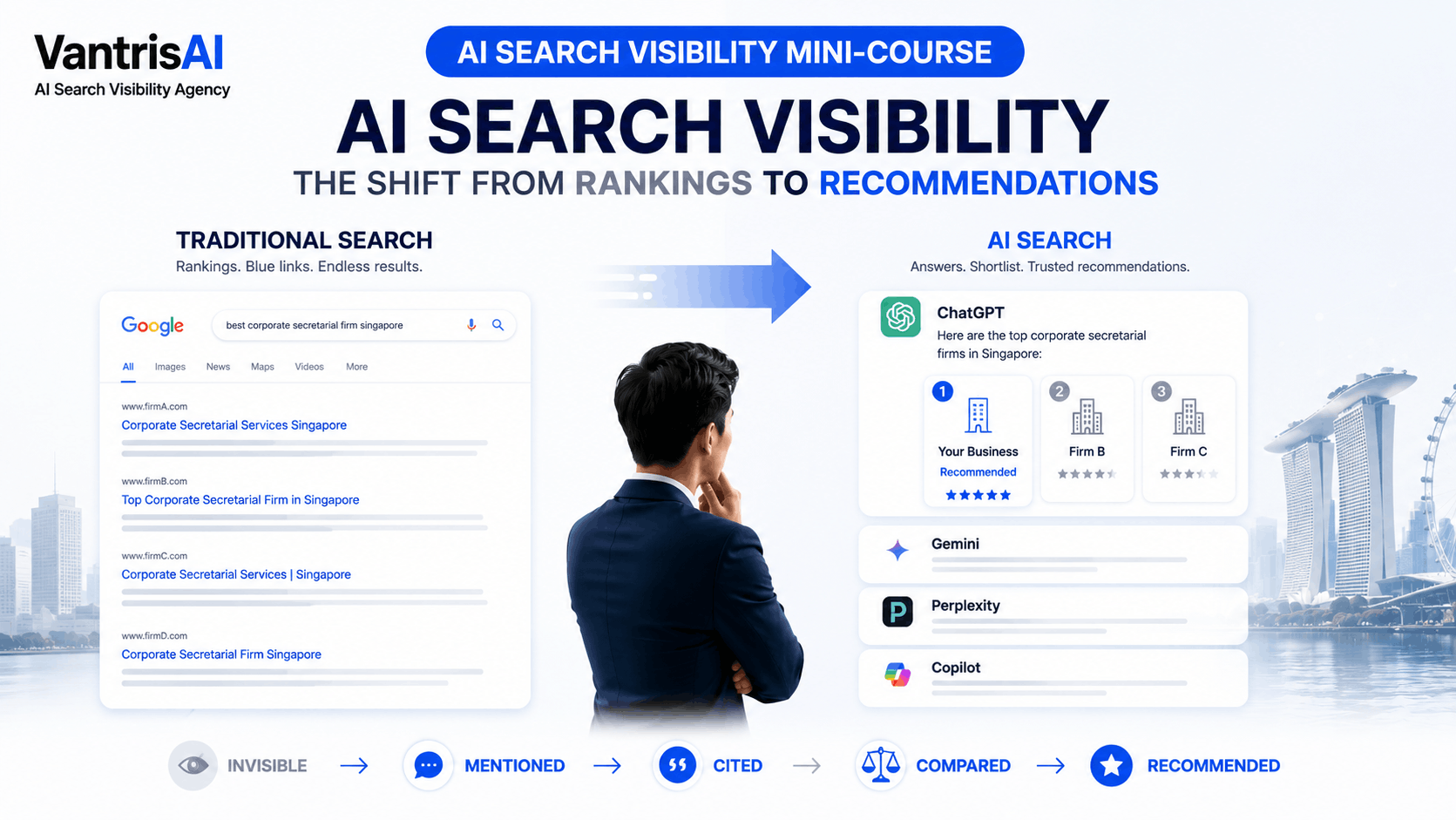
This roadmap is designed to improve AI Search visibility for businesses by moving through the 5 stages of AI Visibility Ladder. The five stages are:
- Invisible
- Mentioned
- Cited
- Compared
- Recommended
The goal is not to jump straight from invisible to recommended. It is to improve the signals that make each stage more likely.
First, AI must understand your business. Then, AI must be able to extract useful answers from your website. Following that, AI must have enough trust signals to compare and recommend you. This is why the roadmap follows the 3-pillar system:
- AIO: Can AI understand your business?
- AEO: Can AI extract useful answers from your website?
- GEO: Should AI trust, compare, and recommend your business?
The 90-day roadmap is not about doing everything. It is about fixing the highest-leverage constraint first. You can learn more about the full system in the 3 pillars of AI Search Visibility.
Understand the Main Bottleneck Before You Start
Before creating new content, redesigning the website, or investing more in marketing, business owners should first identify the bottleneck. Most AI visibility bottleneck fall into one of three categories.
Bottleneck 1: AI Does Not Understand the Business
This is an AIO problem.
AI may not understand:
- What your business does
- What category you belong to
- Who you serve
- Where you operate
- What services you provide
- What outcome you create
- When your business should be considered
If AI cannot explain your business clearly, it is unlikely to recommend you. The first fix is clarity.
Bottleneck 2: AI Cannot Extract Useful Answers
This is an AEO problem.
AI may understand that your business exists, but your pages may not answer questions clearly enough.
Common issues include:
- Thin service pages
- Vague headings
- No direct answer sections
- No FAQs
- No definitions
- No process explanation
- Important information hidden inside images
- Weak internal linking
If AI cannot extract useful answers, it may not cite your website.
The first fix is page structure.
For more detail, use how to structure website pages for AI search as the companion guide.
Bottleneck 3: AI Does Not Have Enough Proof
This is a GEO problem.
AI may understand what you do and may even cite some content, but still not recommend your business.
Common issues include:
- No case studies
- No testimonials
- No founder or team credibility
- No client results
- No external mentions
- No clear trust signals
- Claims without evidence
- Inconsistent business information across the web
If AI cannot find enough proof, it may hesitate to recommend you.
The first fix is trust.
Read how to build trust signals that help AI cite and recommend your business for a deeper explanation.
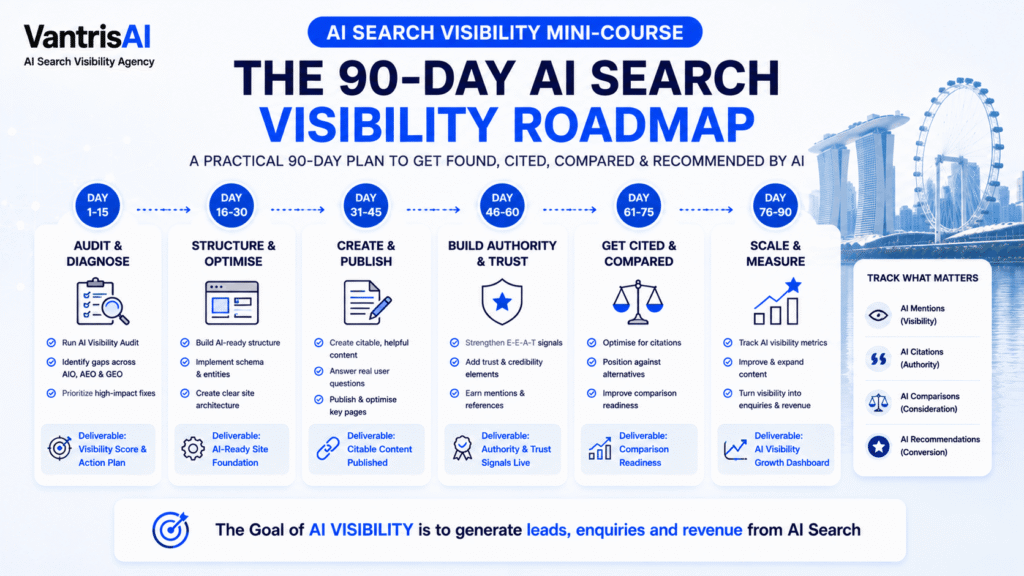
The AI Search Optimisation roadmap
The AI Search Optimisation roadmap can be split into four phases.
| Phase | Timeline | Focus | Main Pillar |
|---|---|---|---|
| Phase 1 | Days 1–14 | Diagnose and clarify | AIO |
| Phase 2 | Days 15–35 | Fix core website pages | AIO + AEO |
| Phase 3 | Days 36–65 | Build answer-ready content and proof | AEO + GEO |
| Phase 4 | Days 66–90 | Monitor, improve, and strengthen trust | GEO + full system |
This sequence matters and there are 3 DO NOT,
- Do not start with random blog content before fixing your homepage and service pages.
- Do not chase visibility before making your business understandable.
- Do not ask AI to recommend you before giving it enough proof.
AI Search Visibility improves when the foundation is repaired in the right order.
Phase 1: Days 1–14
Diagnose Your Current AI Search Visibility
The first phase should focus on diagnosis.
Before you fix anything, you need to know where your business stands.
You are trying to answer four questions:
- Can AI understand your business?
- Can AI extract useful answers from your website?
- Can AI find enough proof to trust you?
- Which visibility stage are you currently in?
This prevents wasted effort.
Many business owners skip this step.
They assume the problem is content volume.
But the real issue may be clarity, structure, or trust.
Start by running an AI Search Visibility Audit.
The audit should assess your website across the three pillars:
- AIO
- AEO
- GEO
The goal is not just to get a score. The goal is to identify what is holding back visibility.
For example:
- A low AIO score means AI may not understand your business clearly.
- A low AEO score means AI may struggle to extract answers from your pages.
- A low GEO score means AI may not have enough proof to trust or recommend you.
This helps you avoid fixing the wrong thing.
You can start with Check Your AI Search Visibility Score .
You can ask several AI tools about your business and remember that you will get different answers everytime. Prompts you can use are as below,
- “What does [Business Name] do?”
- “Is [Business Name] suitable for [specific service]?”
- “Who provides [service] in [location]?”
- “Which companies should I consider for [problem]?”
- “Compare [Business Name] with alternatives.”
- “What are the best companies for [service category] in [market]?”
Record what AI says.
Look for:
- Does AI mention your business?
- Does AI describe your business correctly?
- Does AI cite your website?
- Does AI mention competitors instead?
- Does AI give outdated information?
- Does AI misunderstand your services?
- Does AI recommend your business for relevant queries?
This gives you a baseline.
To understand how AI may choose between businesses, read how AI decides which businesses to mention, cite, compare, and recommend.
Build the First Fix List
At the end of Phase 1, create a first fix list. Do not create a list of 50 tasks. Create a focused list based on the weakest pillar where is being showed in VantrisAI audit tool that we built.
If AIO is weakest, your first fixes may be:
- Rewrite homepage headline
- Clarify service names
- Improve About page
- Add location and audience clarity
- Connect related pages
If AEO is weakest, your first fixes may be:
- Add direct answer blocks
- Add FAQs
- Improve headings
- Expand service pages
- Add process sections
If GEO is weakest, your first fixes may be:
- Add case studies
- Add testimonials
- Add founder credibility
- Add proof to service pages
- Fix inconsistent business profiles
This becomes your working roadmap moving forward.
Phase 2: Days 15–35
Fix Core Website Structure
After diagnosis, the next step is to fix your core pages.
This phase focuses on the pages that matter most for business understanding and buyer intent.
The priority pages are:
- Homepage
- Main service pages
- About page
- Case study pages
- Audit or diagnostic page
- Key industry or use case pages
Always remember, do not start by publishing dozens of articles. Fix the pages that define your business first.
Rewrite the Homepage for AI Clarity
Your homepage should act as your business identity page. It should make your business clear to both humans and AI.
You may use this structure:
- Clear headline
- Direct explanation
- Who you help
- Problem you solve
- Your system or method
- Main services
- Proof
- Educational links
- CTA
For an AI Search Visibility business, the homepage should quickly communicate:
- The business helps companies become more visible in AI-generated answers
- It helps AI tools understand, cite, compare, and recommend businesses
- It uses AIO, AEO, and GEO as the diagnostic structure
- It serves a clear market or customer type
- The next step is to run an audit or book a consultation
This gives AI a stronger entity signal.
Rebuild Main Service Pages
Each service page should answer the questions a buyer and AI would ask.
A strong service page should include:
- What the service is
- Who it is for
- What problem it solves
- Why the problem matters
- How the service works
- What is included
- What outcome it supports
- What proof supports it
- FAQs
- CTA
Strengthen the About Page
Your About page should support trust and entity clarity.
It should include:
- Company description
- Founder story
- Category definition
- Market served
- System or methodology
- Proof
- Case study references
- Clear positioning
- CTA
Fix Basic Technical Accessibility
AI search still depends on discoverable content.
Your website should make important information accessible.
Check:
- Are important pages indexable?
- Are important links crawlable?
- Is key content available as text?
- Are pages loading properly?
- Are important pages blocked by robots.txt?
- Are internal links working?
- Are canonical tags correct?
- Is the site mobile-friendly?
- Are images compressed?
- Are page titles and meta descriptions clear?
- Is structured data used where appropriate?
This does not mean every business owner needs to become technical.
But basic accessibility matters.
If AI and search systems cannot access or understand your pages, your content has less chance of being used.
Phase 3: Days 36–65
Build Answer-Ready and Trust-Ready Assets
Once the foundation pages are clearer, Phase 3 focuses on building assets that support AEO and GEO.
This is where you create the content and proof AI can use.
The goal is not content volume.
The goal is structured coverage.
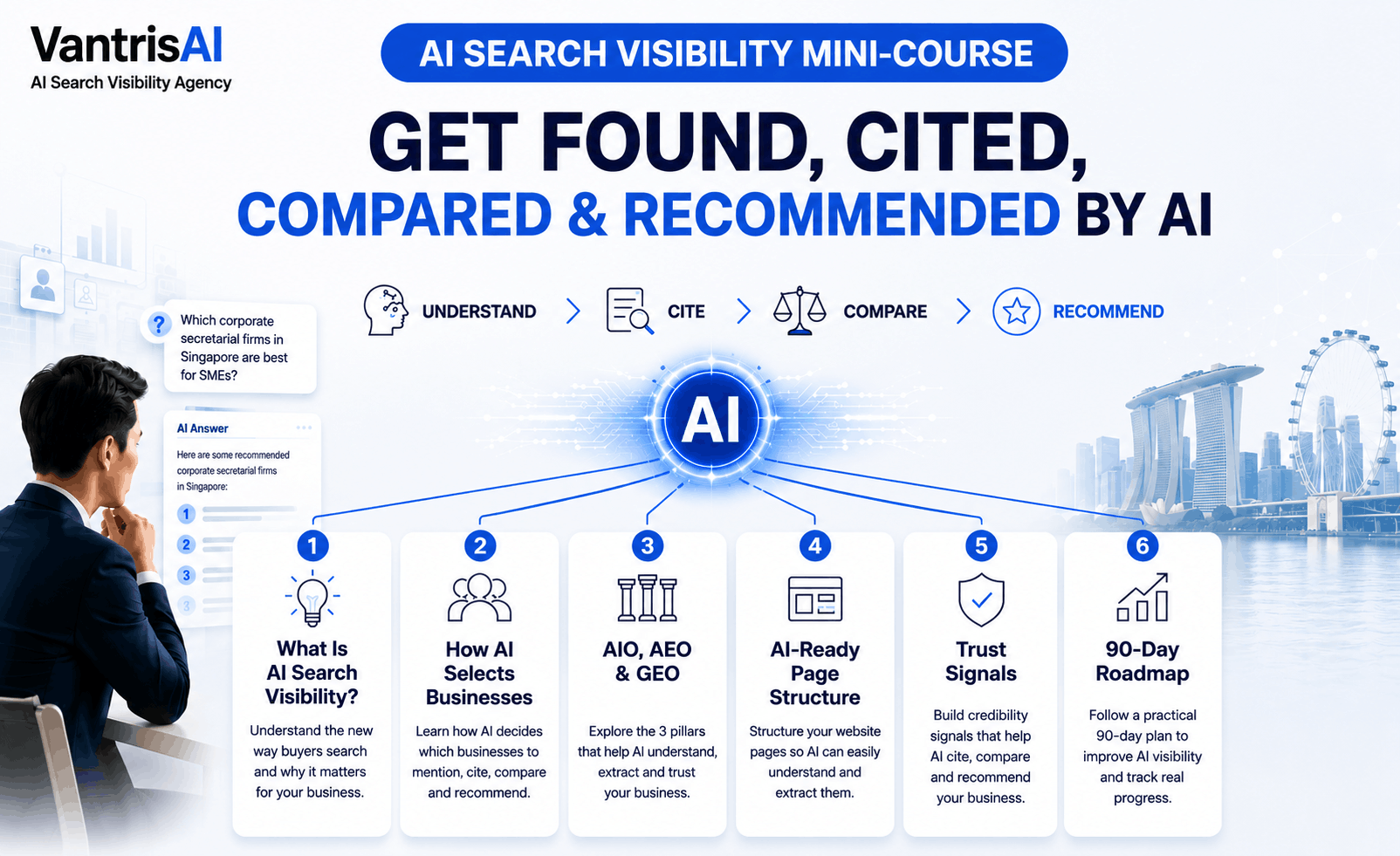
For example, an AI Search Visibility mini-course works because each article supports the central topic from a different angle:
- What AI Search Visibility means
- How AI selects businesses
- The 3 pillars: AIO, AEO, GEO
- Page structure for AI search
- Trust signals
- 90-day implementation roadmap
This creates a semantic content network around AI Search Visibility.
Build Direct Answer Sections
Review your important pages and add direct answer sections near the top.
A direct answer should:
- Explain the main topic clearly
- Use simple language
- Be specific
- Avoid vague claims
- Answer the query in 60 to 100 words where possible
Examples:
“AI Search Visibility is the ability of your business to be understood, cited, compared, and recommended by AI tools when buyers ask relevant questions.”
“An AI Search Visibility Audit checks whether AI systems can understand your business, extract answers from your pages, and find enough proof to trust or recommend you.”
Direct answers improve AEO.
They make your content easier to extract.
Add FAQ Sections
FAQs help AI answer buyer questions.
Add FAQs to:
- Homepage
- Service pages
- Audit page
- Case study pages
- Mini-course articles
- Strategy call page
Create or Improve Case Studies
Case studies are one of the strongest GEO assets. Start with one strong case study and build on it. A strong case study should include:
- Starting problem
- Business type
- Initial visibility state
- What was fixed
- Timeline
- Result
- Commercial outcome
- What this proves
- Related service
- CTA
Add Testimonials and Proof Blocks
Add proof blocks to your important pages. A proof block can be short.
For example:
“Client example: A B2B supplier started receiving AI referral traffic and qualified enquiries after improving its website structure, FAQs, and trust signals.”
Or:
“After restructuring key service pages and proof sections, the business became easier for AI tools to understand and describe accurately.”
Proof blocks should appear close to relevant claims. If a service page says you improve AI visibility, show proof on that page and if an article says trust signals matter, link to a relevant case study.
Phase 4: Days 66–90
Test AI Outputs Again
Repeat the AI tests from Phase 1.
Ask:
- What does [Business Name] do?
- Who provides [service] in [location]?
- Which companies help with [problem]?
- Compare [Business Name] with alternatives.
- Is [Business Name] suitable for [specific buyer]?
- What are the best providers for [service category]?
Compare the answers with your baseline.
Look for changes:
- Are you now mentioned?
- Are you described more accurately?
- Are your pages cited?
- Are your services clearer?
- Are competitors still appearing ahead of you?
- Is AI using outdated information?
- Are you being compared?
- Are you being recommended?
This tells you whether the fixes are starting to influence AI understanding.
Check AI Referral Traffic
Review your analytics. Look for referral traffic from AI tools and AI-related sources.
You may not always see everything clearly, but look for signals from:
- ChatGPT
- Perplexity
- Copilot
- Gemini-related surfaces where visible
- Other AI-assisted discovery channels
Track:
- Sessions
- Landing pages
- Engagement
- Enquiries
- Conversions
- Form submissions
- WhatsApp clicks
- Strategy call bookings
AI visibility should eventually connect to commercial outcomes.
Improve the Weakest Remaining Pillar
After monitoring, identify the weakest remaining pillar.
If AIO is still weak, improve clarity.
Actions may include:
- Rewrite vague sections
- Clarify service labels
- Add industry pages
- Strengthen location relevance
- Improve About page
- Add internal links
If AEO is still weak, improve extraction.
Actions may include:
- Add direct answers
- Add FAQs
- Add comparison sections
- Add process explanations
- Improve headings
- Expand thin pages
If GEO is still weak, improve trust.
Actions may include:
- Add case studies
- Add testimonials
- Add founder profile
- Add external mentions
- Strengthen proof blocks
- Improve review signals
The roadmap is iterative. Fix, monitor, improve.
Build External Trust Signals
Once your own site is clearer, build trust beyond your website.
External trust signals may include:
- LinkedIn thought leadership
- Business directories
- Partner mentions
- Media features
- Podcast interviews
- Guest articles
- Client mentions
- Review platforms
- Industry references
- Original research
- Public reports
The End Goal of the 90-Day Roadmap: More Qualified Enquiries
The end goal of the 90-day AI Search Visibility roadmap is not to “look better” in AI tools. The goal is to turn AI discovery into qualified enquiries.
A clearer website can help AI understand your offer. Answer-ready pages can help AI cite your expertise. Trust signals can help AI compare and recommend your business. Monitoring can show whether AI visibility is turning into referral traffic, enquiries, WhatsApp messages, form submissions, and strategy calls.
VantrisAI’s strength is not only explaining AI Search Visibility as a concept. The work is tied to commercial outcomes: helping businesses structure their websites so AI tools have a better chance of understanding, citing, comparing, and recommending them. For clients, this has led to AI referral traffic and qualified enquiries after their websites were improved for clarity, extraction, and trust.
That is why this roadmap should not be treated as a technical SEO checklist.
It is a commercial visibility plan. The outcome is not just more content. The outcome is a business that is easier for AI to understand, easier for buyers to trust, and more likely to generate enquiries from AI-assisted discovery.
Summary
A 90-day AI Search Visibility roadmap helps business owners improve how AI tools understand, cite, compare, and recommend their business. When buyers ask AI who they should consider, your business should have a fair chance of being included in the answer.
This article completes the AI Search Visibility Mini-Course.
Across the six lessons, we covered:
- What AI Search Visibility means
- How AI decides which businesses to mention, cite, compare, and recommend
- The 3 pillars of AI Search Visibility: AIO, AEO, and GEO
- How to structure website pages for AI understanding and extraction
- How to build trust signals that help AI cite and recommend your business
- The 90-day roadmap for improving AI Search Visibility
You’ve come so far in this mini course and I appreciate you. If you haven’t yet, you can run the AI Visibility Audit to check your AIO, AEO, and GEO pillar score. It helps identify whether your business has a clarity problem, an extraction problem, or a trust problem, so you know what should be fixed first.
After running the audit and should you want help interpreting your score and deciding what to fix first, book an AI Search Visibility strategy session with us.