Table of Contents
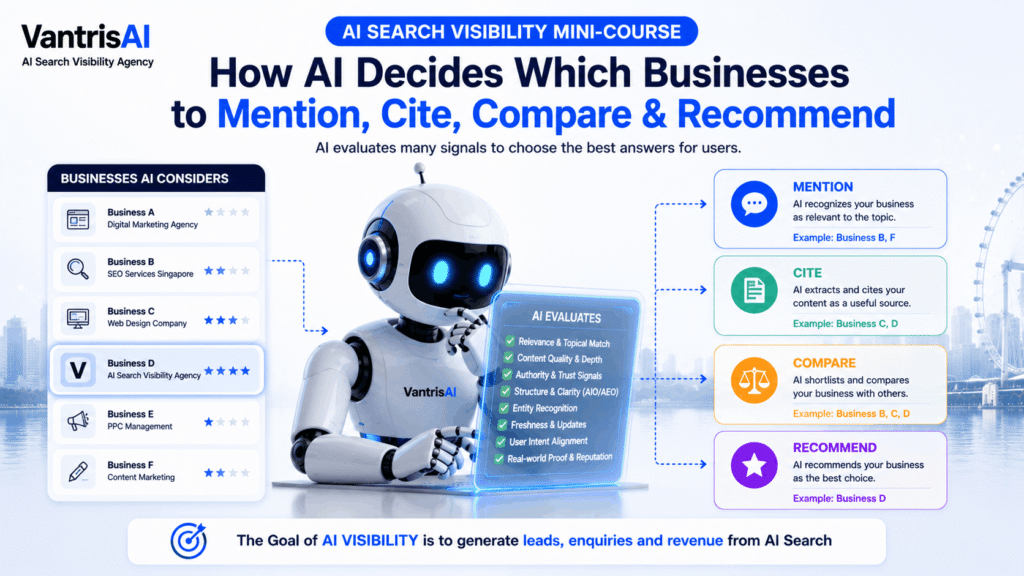
AI systems do not simply recommend the “best” business. Here’s how AI selects businesses.
They usually include businesses that are easier to understand, easier to verify, easier to compare, and easier to support with available information.
When a buyer asks AI tools such as ChatGPT, Gemini, Perplexity, Copilot, or Google AI features for business recommendations, AI looks for clear signals. It needs to understand what your business does, who you serve, what evidence supports your claims, and whether your website or online presence gives enough confidence to include you in the answer.
For business owners, this means AI visibility is not just about having a website. It is about making your business clear enough, structured enough, and credible enough for AI to mention, cite, compare, or recommend.
Why This Matters to Business Owners
Most business owners assume AI recommendations work like traditional Google rankings.
They think:
“If my website ranks well, AI should mention me.”
Or:
“If my company is good, AI should recommend us.”
But AI search does not work exactly like traditional search.
When a buyer asks Google, they usually see a list of results.
When a buyer asks AI, they may receive a summarised answer, a few suggested companies, a comparison, or a direct recommendation.
That means AI is not just showing information.
It is interpreting information.
It is deciding what to include, what to leave out, and how to explain the options.
This is why some businesses appear in AI-generated answers while others do not.
The businesses that appear are not always the largest.
They are not always the most established.
They are not always the most capable.
Many times, they are the businesses with clearer information, stronger structure, better proof, and more visible trust signals.
That is the opportunity.
If your business is already credible offline, but AI is not mentioning you online, the issue may not be your capability.
The issue may be that AI does not have enough structured information to understand, cite, compare, or recommend you.
AI Does Not Choose Businesses the Way Humans Do
A human buyer may choose your business because of a referral, a past relationship, a sales conversation, or reputation in the market.
AI does not experience your business that way.
AI depends on available information.
It looks at what can be found, understood, extracted, and supported.
This creates a gap between real-world credibility and AI-visible credibility.
A business may be very strong in the real world but weak in AI search because its website does not clearly explain:
- What the business does
- Who the business serves
- What category it belongs to
- What problems it solves
- What outcomes it creates
- What proof supports its claims
- What makes it different from alternatives
- Why it should be trusted
If these signals are missing, vague, or scattered, AI may skip the business. Not because the business is poor. But because the business is difficult for AI to understand and justify.
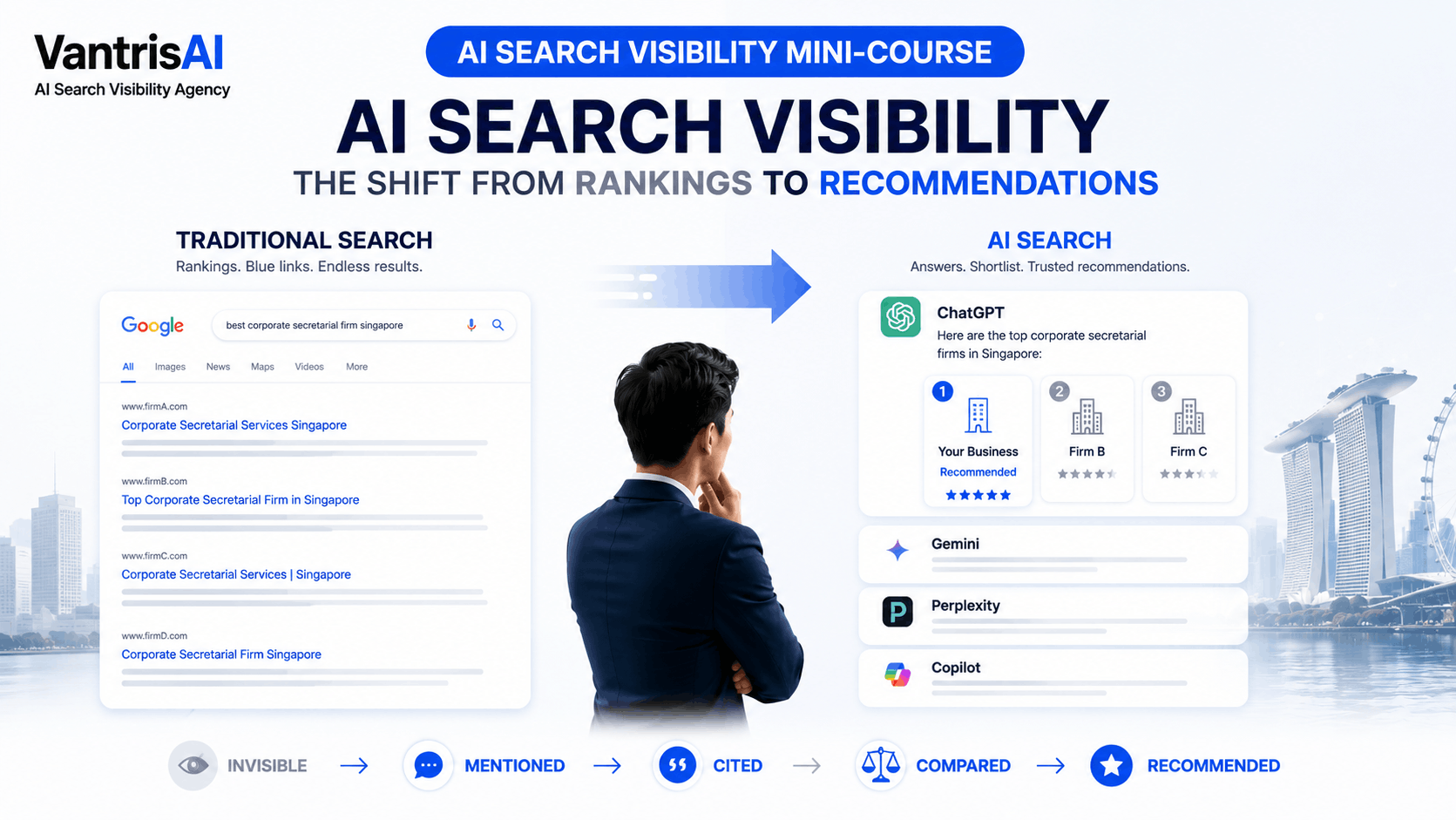
The AI Selection Ladder
At VantrisAI, we use a simple ladder to explain how AI visibility usually develops.
This ladder has 5 stages:
- Invisible
- Mentioned
- Cited
- Compared
- Recommended
Each stage requires stronger signals than the stage before it.
A business does not usually move from invisible to recommended in one step.
First, AI needs to know the business exists.
Then, AI needs to understand what the business does.
Then, AI needs to extract useful information from the business.
Then, AI needs to compare the business against alternatives.
Finally, AI needs enough confidence to recommend the business in a relevant context.
This is why AI Search Visibility should be treated as a structured progression, not a single ranking position.
Stage 1: Invisible
The first stage is invisible.
This means AI does not mention your business when users ask relevant questions.
For example, a buyer asks:
“Which companies help Singapore businesses improve AI search visibility?”
If VantrisAI does not appear in that answer, then VantrisAI is invisible for that query.
The same applies to any business.
A corporate secretarial firm may be invisible for:
“Which corporate secretarial firms are suitable for SMEs in Singapore?”
An accounting firm may be invisible for:
“Which accounting firms can help startups with tax and compliance?”
A B2B supplier may be invisible for:
“Which companies supply automotive spare parts in Singapore?”
Invisibility usually happens because AI does not have enough clear signals to include the business.
Common reasons include:
- The website is too vague
- The service pages are too thin
- The business category is unclear
- The location is not obvious
- The content does not answer buyer questions
- The business has weak proof signals
- The online presence is inconsistent
- The business is not connected to relevant topics
The first goal is to become understandable enough to be mentioned.
Stage 2: Mentioned
The second stage is mentioned.
This means AI knows your business exists and may include your name in an answer.
This is an important step.
If AI mentions your business, it means your entity is starting to become visible.
However, being mentioned is not the same as being trusted.
A mention may look like this:
“Some companies in this space include Company A, Company B, and Company C.”
At this stage, AI may not explain your business deeply.
It may not cite or recommend your website.
It may simply list you as one of several possible businesses.
To move from mentioned to cited, your website needs to provide extractable information.
That means your pages must answer relevant questions clearly enough for AI to use them as a source.
Stage 3: Cited
The third stage is cited.
This means AI can use your content as supporting material in an answer.
Citation is stronger than mention.
A citation suggests that your content contains useful information AI can extract and reference.
For a business website, citation usually depends on page structure.
AI is more likely to cite pages that include:
- Clear definitions
- Direct answers
- Specific explanations
- Well-structured headings
- FAQs
- Service details
- Use cases
- Step-by-step processes
- Comparison sections
- Proof-backed statements
A page that only says “we provide quality solutions” is difficult to cite.
A page that clearly explains a service, who it is for, how it works, and what outcomes it supports is easier to cite.
This is where AEO becomes important.
AEO stands for Answer Engine Optimisation.
It helps AI extract answers from your website and if your AEO is weak, AI may know your business exists but still not use your pages as a source.
Stage 4: Compared
The fourth stage is compared.
This is when AI can place your business alongside other businesses and explain the difference.
For example, AI may say:
- Company A is suitable for larger enterprises
- Company B is suitable for SMEs
- Company C is suitable for niche B2B industries
- Company D is known for a specific type of service
To be compared, your positioning must be clear.
AI needs to understand where you fit in the market.
This requires more than listing services.
It requires clear answers to questions such as:
- Who are you best suited for?
- What type of client do you serve best?
- What problem do you solve better than general providers?
- What industry or segment do you specialise in?
- What is your method or process?
- What proof supports your positioning?
- How are you different from alternatives?
Without this information, AI may not know how to describe your business in a comparison.
And if AI cannot compare you, it may avoid recommending you.
Comparison is a bridge between visibility and recommendation.
Stage 5: Recommended
The final stage is recommended.
This is when AI suggests your business as a suitable provider for a relevant query.
For example:
“For Singapore SMEs looking to improve AI search visibility, VantrisAI may be a relevant option because it focuses on AI Search Visibility audits, AIO, AEO, GEO, and structured website improvements for AI inclusion.”
This is the stage most business owners want.
But recommendation requires the strongest set of signals.
AI needs enough confidence to justify why your business belongs in the answer.
It may look for:
- Clear service relevance
- Strong topical alignment
- Specific business positioning
- Case studies
- Testimonials
- Founder or team credibility
- External mentions
- Consistent business information
- Helpful educational content
- Proof that the business has experience in the category
In simple terms:
AI may mention a business when it knows the business exists.
AI may cite a business when it can extract useful information.
AI may compare a business when it understands the positioning.
AI may recommend a business when it has enough evidence to support inclusion.
How AI Selects Businesses
Although AI systems are complex, business owners can understand the selection process through four practical signals.
These are:
- Clarity
- Extractability
- Comparability
- Trust
If your website improves these four areas, you increase the probability that AI can include your business in relevant answers.
Signal 1: Clarity
Clarity answers the question:
“Can AI understand what this business does?”
This is the foundation.
If AI cannot understand your business clearly, nothing else matters.
Your website should make these points obvious:
- Your business name
- Your category
- Your core services
- Your target market
- Your location
- Your ideal customer
- Your main outcome
- Your positioning
Many businesses fail at this stage because their websites are written in vague marketing language.
Signal 2: Extractability
Extractability answers the question:
“Can AI pull useful answers from this page?”
A business can be clear but still hard to cite.
This happens when the website has good information but poor structure.
AI needs content that is easy to extract.
Strong extractability comes from:
- Direct answer sections
- Clear H2 and H3 headings
- Definition blocks
- FAQs
- Lists
- Tables
- Step-by-step explanations
- Process breakdowns
- Service summaries
- Use case sections
- Comparison content
For example, if a page is about AI Search Visibility, it should define AI Search Visibility near the top.
If a page is about corporate secretarial services, it should explain what the service includes.
If a page is about commercial contract law, it should answer common buyer questions directly.
Do not make AI guess.
Do not hide important information in long paragraphs.
Do not rely only on branding images.
The easier your content is to extract, the easier it is for AI to cite.
Signal 3: Comparability
Comparability answers the question:
“Can AI understand how this business is different from others?”
This is where many service businesses are weak.
They describe what they do, but not why they are a better fit for a specific type of buyer.
If every company says:
- Professional service
- Experienced team
- Reliable support
- Customised solutions
- Trusted by clients
Then AI has very little to compare.
To become comparable, your website should explain:
- Who you are best for
- Who you may not be best for
- What industries you specialise in
- What makes your approach different
- What type of problem you solve best
- What proof supports your claims
- How your process works
- What outcomes clients can expect
Comparability does not mean attacking competitors.
It means making your own positioning specific.
For example:
“VantrisAI is best suited for business owners who want to understand why AI is not mentioning, citing, or recommending their business, and want a structured 90-day roadmap to improve their AI Search Visibility.”
This gives AI a clear fit and this increase the probability to place side by side for comparision.
Signal 4: Trust
Trust is what moves a business closer to recommendation.
AI needs proof. Not just claims.
A website may say:
“We are a leading provider.”
But without evidence, that claim is weak. Stronger trust signals include:
- Case studies
- Client results
- Testimonials
- Reviews
- Founder profiles
- Team credentials
- Media mentions
- Awards
- Certifications
- Industry references
- Public data
- External citations
- Consistent company information
Trust helps AI justify inclusion.
Without trust signals, AI may understand your business but still hesitate to recommend it.
Why “Best Company” Claims Do Not Work Well for AI
Many businesses describe themselves with phrases such as:
- Best in class
- Leading provider
- Trusted expert
- One-stop solution
- Award-winning service
- Customer-focused team
- Reliable partner
These phrases are common.
But they are not very useful by themselves.
AI needs evidence.
If you say you are trusted, show testimonials.
If you say you are experienced, show years, projects, industries, or case studies.
If you say you help clients get results, show examples.
If you say you specialise in a niche, show dedicated pages and proof. It gives AI something to understand and something to support.
How AI May Interpret Your Website
AI does not look at your website the way a human visitor does. A human visitor may respond to design, tone, images, layout, and brand feeling. AI is more dependent on meaning.
It tries to interpret:
- Main topic
- Entity relationships
- Service relevance
- Content structure
- Factual claims
- Supporting evidence
- Internal links
- External references
- Author or business credibility
- Consistency across sources
This means a beautiful website can still be weak for AI.
On the other hand, a simple website with clear structure, strong explanations, and good proof may perform better in AI visibility.
What Makes a Business Mentionable?
A business becomes mentionable when AI can identify it as a relevant entity.
To become mentionable, your website and online presence should clearly show:
- Business name
- Business category
- Services
- Location
- Audience
- Market relevance
- Basic credibility
- Topical connection
The stronger these connections are, the easier it is for AI to identify when VantrisAI is relevant.
What Makes a Business Citable?
A business becomes citable when its content can support an answer.
To become citable, your pages should include:
- Definitions
- Explanations
- Structured sections
- Direct answers
- Useful examples
- FAQs
- Clear service descriptions
- Process explanations
- Data or observations where available
- Specific claims with support
Each article should help AI understand the topic and connect VantrisAI to the category.
What Makes a Business Comparable?
A business becomes comparable when AI can understand its positioning against alternatives.
To become comparable, your website should explain:
- Your niche
- Your ideal customer
- Your method
- Your strengths
- Your limitations
- Your category
- Your use cases
- Your process
- Your proof
- Your differences from general provider
The objective is to improve the probability that AI systems can understand, cite, compare, and recommend the business.
The Role of AIO, AEO, and GEO
The VantrisAI system uses the 3 pillars of AI Search Visibility to diagnose what is holding back AI Search Visibility. These are AIO, AEO, and GEO.
AIO: Helping AI Understand You
AIO stands for AI Overview Optimisation.
It answers the question:
“Can AI understand your business?”
AIO is connected to entity clarity.
It includes your business category, service descriptions, homepage clarity, audience, location, and topical relevance.
If AIO is weak, AI may not understand where your business fits.
This can prevent your business from being mentioned.
AEO: Helping AI Extract You
AEO stands for Answer Engine Optimisation.
It answers the question:
“Can AI extract useful answers from your pages?”
AEO is connected to content structure.
It includes direct answers, FAQs, clear headings, definitions, service explanations, and answer-ready content blocks.
If AEO is weak, AI may understand that your business exists but may not cite your content.
GEO: Helping AI Trust and Recommend You
GEO stands for Generative Engine Optimisation.
It answers the question:
“Should AI trust and include your business?”
GEO is connected to proof and authority.
It includes case studies, testimonials, reviews, founder credibility, external mentions, and consistent brand signals.
If GEO is weak, AI may understand and cite you but may still hesitate to recommend you.
If AI Does Not Mention You
Your likely issue is AIO.
Ask:
- Is your business category clear?
- Are your services clearly described?
- Is your market or location obvious?
- Is your audience stated?
- Is your website connected to the right topics?
The first fix is to clarify your entity.
If AI Mentions You But Does Not Cite You
Your likely issue is AEO.
Check the following,
- Do your pages answer questions directly?
- Do you have clear headings?
- Do you have FAQs?
- Are your explanations specific?
- Can AI extract useful answers from your pages?
The first fix is to restructure your content for extraction.
If AI Cites You But Does Not Recommend You
Your likely issue is GEO.
Check the following,
- Do you have case studies?
- Do you show proof?
- Do you have testimonials?
- Do you show founder or team credibility?
- Do other trusted sources mention you?
- Are your claims supported?
The first fix is to strengthen trust signals.
If AI Mentions Competitors But Not You
This usually means your competitors have stronger visible signals for that query.
Check if they may have the following,
- Clearer service pages
- More relevant content
- Better category association
- Stronger third-party mentions
- More structured FAQs
- More proof
- Better internal linking
- More specific positioning
This does not always mean they are better. It means AI can understand and support them more easily. Your job is to close that visibility gap.
How to Improve Your Chance of Being Included by AI
To improve your chance of being mentioned, cited, compared, or recommended by AI, focus on five practical areas.
1. Make Your Business Category Obvious
Do not make AI infer what your business does.
Say it clearly.
Example:
“VantrisAI is an AI Search Visibility specialist for business owners.”
This is better than:
“We help brands unlock growth through innovation.”
Clear beats clever.
2. Answer Buyer Questions Directly
AI is often responding to questions.
Your website should answer those questions.
Examples:
- What is this service?
- Who is it for?
- How does it work?
- How much does it help?
- What problem does it solve?
- What should a buyer consider?
- What makes this provider credible?
Direct answers increase extraction potential.
3. Show Proof, Not Just Claims
Every important claim should be supported.
If you say you help businesses improve AI visibility, show examples.
If you say you are trusted, show testimonials.
If you say you have a process, explain it.
If you say you understand the category, publish useful reference content.
Proof turns marketing language into evidence.
4. Build a Clear Topical Network
One page alone is rarely enough.
Your website should build a connected network of related pages.
It is consistently covering the topic from multiple important angles.
5. Monitor AI Outputs
Business owners should not only look at Google rankings.
They should also check whether AI tools are:
- Mentioning the business
- Citing the website
- Comparing the business
- Recommending the business
- Showing outdated information
- Mentioning competitors instead
- Ignoring important service categories
This gives you practical feedback. Basically, if AI does not understand you, fix clarity and if AI does not cite you, fix structure. Lastly, if AI does not recommend you, fix proof.
The Commercial Impact of AI Selection
AI selection matters because it can influence who enters the buyer’s shortlist. If a buyer asks AI for recommendations and your business does not appear, you may lose the opportunity before the buyer even visits your website.
That is the new risk in the AI Search era.
In the past, you might have worried about being on page two of Google. Now, the bigger risk is not being part of the AI-generated answer at all.
This affects:
- Opportunities
- Enquiries
- Client acquisition
- Brand visibility
- Pipeline growth
- Competitive positioning
AI visibility is not a technical vanity metric. It is a commercial visibility issue.
The question is no longer only:
“Can people find us on Google?”
The better question is:
“When buyers ask AI who they should consider, are we included in the answer?”
Summary
AI systems do not simply recommend the best business. They include businesses that are easier to understand, easier to extract, easier to compare, and easier to support with evidence.
This is why AI Search Visibility depends on four major signals:
- Clarity
- Extractability
- Comparability
- Trust
At VantrisAI, we connect these signals to the AI Selection Ladder:
- Invisible
- Mentioned
- Cited
- Compared
- Recommended
A business becomes mentionable when AI understands it.
A business becomes citable when AI can extract useful answers from its pages.
A business becomes comparable when AI understands its positioning.
A business becomes recommendable when AI has enough proof and trust signals to include it confidently.
If AI is mentioning your competitors but not your business, it does not always mean they are better.
It may mean they are clearer, better structured, and easier for AI to justify.
That gap can be fixed.
Next Lesson
In the next lesson, we will explain the 3 pillars of AI Search Visibility: AIO, AEO, and GEO.
This will help you understand whether your business has a clarity problem, an extraction problem, or a trust problem.
Once you know which pillar is weakest, you can fix the right thing first.
Want to know whether AI can understand, cite, compare, and recommend your business?
Run the VantrisAI AI Search Visibility Audit and check your AI Search Visibility Score.
Back to AI Search Visibility Mini-Course Hub or learn more about what AI Search Visibility means.
Learn how VantrisAI improved from 51 to 92 in 22 days.